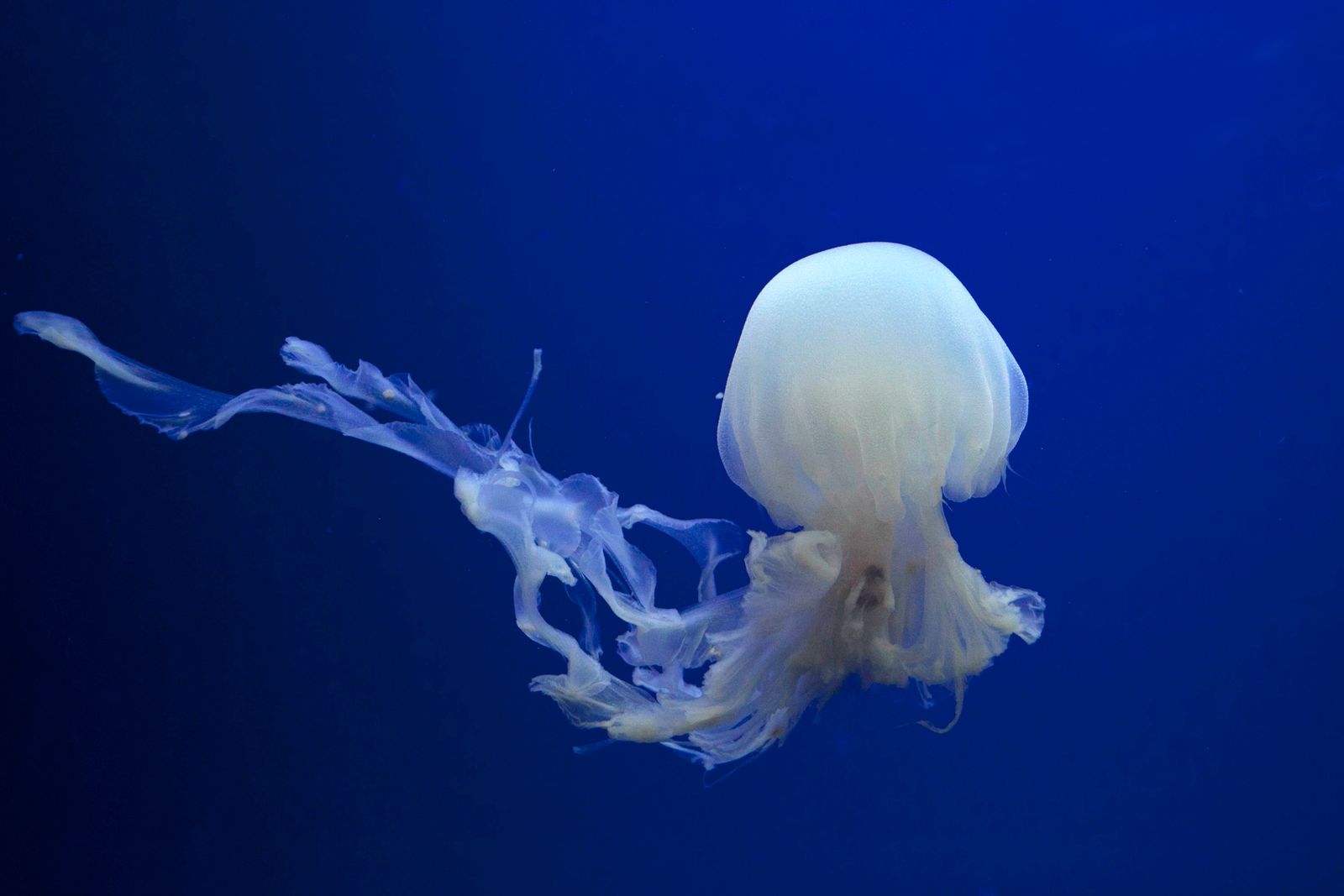
In coastal waters, a jellyfish smaller than a fingernail can carry out one of the most striking reversals known in animal development. Adult Turritopsis dohrnii measure about 4.5 millimetres across, and the Natural History Museum describes how a damaged or starving medusa can shrink inward, reabsorb its tentacles, lose the ability to swim and settle as a cyst.
Under suitable conditions, that cyst develops into a juvenile polyp. The polyp can then grow into a colony and eventually bud off new medusae carrying the same genome. This extraordinary form of life-cycle reversal has made the species a valuable model for studying how specialised cells can change identity.
What actually happens when the jellyfish rewinds
The sequence begins when a medusa stops swimming and its bell contracts. Its tentacles are absorbed into the shrinking body, which settles on a hard surface as a small cyst. The animal has not simply healed its adult form. It has dismantled much of the medusa body plan and entered an intermediate stage between the adult and the polyp.
Published studies place the complete reversal from medusa through cyst to polyp within roughly 24 to 72 hours, although the timing varies with the trigger and experimental conditions. A stolon can extend from the cyst, followed by the formation of a solitary reversed polyp. That polyp may reproduce asexually, establish a colony and later release new medusae.
This distinction matters when describing the jellyfish as the “same animal.” The reversed polyp develops from tissue belonging to the original medusa, and the medusae later produced by the polyp are genetically identical. Whether those later medusae should be considered the same individual is less a settled biological fact than a question about how individuality is defined in a colonial animal.
Reversal is common under stress, but it is not guaranteed
A 2025 experiment in Invertebrate Biology tested 102 newborn medusae exposed to heat, low salinity, wounding or starvation. Heat produced the highest cyst-formation rate at 88%, followed by starvation at 80%, wounding at 72% and altered salinity at 64%.
The experiment also showed why the species’ ability should not be described as automatic. Across all treatments, 22% of the medusae died without forming cysts. Even genetically identical medusae produced by the same colony did not always respond in the same way.
Cyst formation took between 12 and 60 hours in that study. Heat produced the fastest response, while starvation took the longest. Earlier work has also identified damage, chemical exposure and temperature changes as reversal triggers, while gene-expression research describes medusae responding to damage or senescence.
The mechanism is called transdifferentiation
The leading explanation for the reversal is transdifferentiation, a process in which a specialised mature cell changes into another specialised cell type. Medusa and polyp tissues are not interchangeable, so reversing the body plan requires cells committed to adult functions to adopt roles needed by the juvenile polyp.
A 2021 gene-expression study by Yui Matsumoto and Maria Pia Miglietta examined the medusa, cyst, reversed-polyp and colonial-polyp stages. It found that the cyst showed increased activity among genes associated with ageing, lifespan, DNA repair and responses to cellular damage. The reversed polyp also had a gene-expression profile distinct from that of a polyp produced through ordinary budding.
The cellular account is still being refined. Researchers have strong evidence that reprogramming occurs during the cyst stage, but direct cell-by-cell tracking and single-cell transcriptomic work would be needed to map exactly which medusa cells become which polyp tissues.
Maria Pia Miglietta’s laboratory at Texas A&M University at Galveston studies the genetics of the reversal. Miglietta has explained that cells inside the cyst take on functions required by the polyp and then reintegrate into the reorganised animal.
Why “biologically immortal” needs qualification
Turritopsis dohrnii is called biologically immortal because repeated life-cycle reversal could, in principle, interrupt the normal progression toward senescence. That does not mean every medusa reverses successfully, that any known individual has lived indefinitely, or that the animal cannot die.
The species remains vulnerable to predators, disease and physical destruction. An August 2026 Guardian profile reported that the animals could theoretically continue cycling in laboratory conditions, while many in the wild are eventually eaten.
No experiment has followed a single jellyfish for centuries, let alone millennia. The strongest defensible claim is that the species has no demonstrated fixed limit on the number of times its life cycle can reverse under favourable conditions. Its theoretical potential is far larger than the observational record.
A silent invasion carried by ships
Turritopsis dohrnii is now recorded across widely separated tropical and temperate waters. Ships and ballast water offer a plausible route for that dispersal because stressed medusae can revert to the tougher, attached polyp stage during long journeys.
In the peer-reviewed paper “A silent invasion,” Miglietta and Harilaos Lessios identified a human-mediated worldwide introduction of the species. Their mitochondrial 16S analysis included samples from Japan, the Pacific and Atlantic coasts of Panama, Florida, Spain and Italy.
The samples were not genetically identical across every examined sequence. Instead, individuals within the identified clade differed by an average of 0.31% of their mitochondrial 16S base pairs, while 15 individuals from Japan, Atlantic Panama, Spain and Italy shared the same haplotype. That low variation across distant locations supports recent, human-assisted dispersal rather than an ancient natural separation among those populations.
The species’ small size and variable appearance help make that spread difficult to notice. Tropical and temperate populations can differ in visible traits even when their sampled mitochondrial sequences are extremely similar, which is why the researchers described the expansion as a silent invasion.
Why humans cannot copy the trick
The jellyfish does not provide a near-term route to reversing human ageing. Its body is far simpler than a human body, and changing the identity of cells inside one tissue is not equivalent to rebuilding an adult vertebrate as an earlier developmental stage.
In an interview with BBC Science Focus, Miglietta said practical applications remain far away. The immediate scientific value lies in identifying which genes change activity during cyst formation and learning how newly reprogrammed cells integrate into functioning tissue.
A report on a 2024 review of the species highlighted changes involving DNA repair, telomere maintenance and cell identity. It also stressed that cellular reprogramming in humans can increase oncogenic risks, particularly when DNA damage and growth controls are not properly contained.
That is an important limit on the comparison. The jellyfish is a natural example of whole-organism cellular plasticity, but the research does not show that its reversal could be transferred safely to humans. It offers a system for studying regeneration, not a blueprint for an immortality treatment.
A difficult animal to study
For an animal famous for escaping one route to death, Turritopsis dohrnii is difficult to maintain in a laboratory. It is sensitive to temperature, water conditions and diet. Miglietta told BBC Science Focus that the animals eat plankton and fish eggs and are remarkably hard to keep alive.
That sensitivity also complicates experiments. A change intended merely to maintain the animals can become a stressor that induces cyst formation, while some medusae die without reversing. Researchers must therefore separate the species’ normal development from responses caused by handling, starvation or altered water conditions.
Those difficulties help explain why major questions remain unresolved. Scientists can document the visible transformation and compare gene activity across its stages, but following individual cells throughout the process requires more specialised experiments.
What the jellyfish does and does not prove
Turritopsis dohrnii demonstrates that an adult body plan need not always represent an irreversible endpoint. Under particular conditions, surviving tissues can reorganise into a juvenile polyp and resume the life cycle from there.
It does not prove that development can be reversed without limits, that every medusa survives the attempt, or that a single individual has persisted for an extraordinary span of time. The 2025 stress experiment showed substantial differences in reversal rates even among closely related medusae exposed to the same conditions.
Nor does the process rebuild the medusa directly. The animal first becomes a cyst, then a polyp. Only after the polyp grows and buds do new medusae enter the water. The result is a repeated developmental cycle carried forward through genetically identical forms, not an adult jellyfish simply becoming a younger version of its existing medusa body.
What the reversal looks like
Under controlled observation, the sequence is compact and physical. Swimming stops. The bell contracts, the tentacles disappear into the shrinking body and the medusa settles as a cyst.
Hours later, the cyst begins reorganising. A stolon forms, followed by a reversed polyp attached to the surface. That polyp can expand into a colony, and the colony can eventually produce medusae capable of swimming and reproducing again.
The animal has not become indestructible, and it has not escaped every form of death. It has done something narrower and scientifically stranger: when the reversal succeeds, an adult stage that normally marks the far end of development becomes a route back to the beginning.