
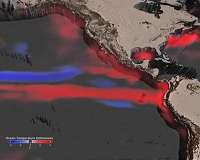
El Nino is a recurring climate pattern characterized by warmer than usual ocean temperatures in the equatorial Pacific. Two back-to-back 3-D visualizations track the changes in ocean temperatures and currents, respectively, throughout the life cycle of the 2015-2016 El Nino event, chronicling its inception in early 2015 to its dissipation by April 2016. Blue regions represent colder and red regions warmer temperatures when compared with normal conditions.
Under normal conditions, equatorial trade winds in the Pacific Ocean blow from east to west, causing warm water to pile up in the Western Pacific, while also causing an upwelling – the rise of deep, cool water to the surface – in the Eastern Pacific. During an El Nino, trade winds weaken or, as with this latest event, sometimes reverse course and blow from west to east.
As a result, the warm surface water sloshes east along the equator from the Western Pacific and temporarily predominates in the Central and Eastern Pacific Ocean. At that same time, cooler water slowly migrates westward just off the equator in the Western Pacific.
The first visualization shows the 2015-2016 El Nino through changes in sea surface temperature as warmer water moves east across the Pacific Ocean. The Eastern Pacific Ocean undergoes the most warming from July 2015 to January 2016.
In the west, just to the north of the equator, cooler waters hit the western boundary and reflect along the equator and then head east starting in February 2016. Just as the warming waves traveled east earlier in the video, these cool waters make their way to the central Pacific, terminating the warming event there.
Hand-in-hand with an El Nino's changing sea surface temperatures are the wind-driven ocean currents that move the waters along the equator across the Pacific Ocean. The second visualization depicts these currents, which here comprise the ocean's surface to a depth of 225 meters: Yellow arrows illustrate eastward currents and white arrows are westward currents.
The El Nino-inducing westerlies – winds coming from the west that blow east – cause the eastward currents to occur in pulses. A good example of one of these pulses can be seen hitting the South American coast on May 15, 2015. By the end of February 2016 trade winds return, as evidenced by the return of westward currents and cool water along the equator, signaling the dissipation of the El Nino.
These visualizations are derived from NASA Goddard's Global Modeling and Assimilation Office, using Modern-Era Retrospective Analysis for Research and Applications (MERRA) dataset, which comprises an optimal combination of observations and ocean and atmospheric models.
Hawaiian biodiversity began declining before humans arrived
New research suggests plant and animal diversity has been on the decline on all Hawaiian Islands, except for the Big Island, for several million years.
Researchers measured the decline using a new biodiversity analysis method. Scientists traced the history of diversity of 14 different groups of birds, insects, spiders and plants.
"It is increasingly appreciated that the biota of … read more
