
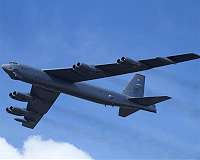
The U.S. Air Force flew two B-52 bombers over the East China Sea and Sea of Japan in what it described as a "routine training" amid trade tensions with China.
Two nuclear-capable B-52H Stratofortress aircraft departed Andersen Air Force Base on the U.S. territory of Guam on Monday, U.S. Pacific Air Force spokeswoman Capt. Victoria Hight Aircraft told the Japan Times.
Spots, a Twitter account tracking movements of military aircraft, showed that the exercise took the bombers over the East China Sea and Sea of Japan for approximately 11 hours.
The jets, which can carry nuclear cruise missiles, are capable of flying at high subsonic speeds at altitudes up to 50,000 feet.
The United States and Japan regularly exercise in the East China Sea, which is part of the Indo-Pacific region. The U.S. Air Force said these missions "have been ongoing since March 2004" and "are consistent with international law and United States' long-standing and well-known freedom of navigation policies."
The East China Sea includes the Senkaku Islands, which are claimed by Japan and China. Beijing, which calls them the Diaoyu, also dispatches government ships and aircraft to the area.
In September 2018, two B-52Hs went over the East China Sea and the highly disputed South China Sea. At the time, Ren Guoqiang, a Chinese Ministry of Defense spokesperson, said at a news briefing: "As for the provocative action taken by the U.S. military aircraft, we are firmly against it and we will take all necessary means to safeguard our rights and interests."
In the South China Sea, six nations have competing claims: China, Taiwan, Vietnam, Malaysia, Brunei and the Philippines. But Beijing, which has military outposts in the South China Sea and sees the sea lanes as vital, has no legal claim to the region, according to an international maritime tribunal ruling in 2016.
The B-52 flight comes as high-level U.S.-China talks were scheduled for Thursday in Washington in an attempt to find a solution to a trade war. Both nations have added tariffs on items each country exports to the other.
In December, President Donald Trump promised not to go through with a planned tariff hike — from 10 percent to 25 percent — on $200 billion worth of Chinese products. In exchange, Chinese President Xi Jinping agreed to purchase a "very substantial" amount of agricultural, energy and industrial product from the United States.
