
The jury is still out as to whether climate change will lead to stronger El Nino events, but while representatives from around 200 countries at the COP24 conference are working to breathe life into the 2105 Paris Agreement, there is a 75-80% chance that a fully-fledged event could be with us in the next couple of months.
El Nino and its cooler cousin, La Nina, are complex naturally occurring climatic phenomena – and nobody really knows if our changing climate will affect them.
El Nino and La Nina are opposite phases of what is known as the El Nino-Southern Oscillation and occur at irregular intervals of between two and seven years.
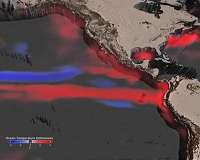
As this animation shows, the first signs of an El Nino are a weakening of the Trade Winds and warmer than usual sea-surface temperatures in the eastern tropical Pacific Ocean. This not only affects fisheries off the coast of South America, but leads to a disruption in weather patterns around the world.
These changing weather patterns can cause heatwaves, drought, wildfires and flooding in different places.
Often, a year after an El Nino, the pendulum swings back and La Nina occurs when the Trade Winds strengthen and surface waters cool in the tropical Pacific Ocean.
According to the World Meteorological Organization there is a 75-80% chance of a fully-fledged El Nino starting within the next couple of months.
Satellite measurements are essential to help predict El Nino and to monitor the effects of an event.
For example, thermal infrared sensors in the Copernicus Sentinel-3 satellites' sea and land surface temperature radiometer measure changes in the temperature of the sea-surface.
Also, by profiling Earth's wind, ESA's newly-launched Aeolus missions is expected to help predict these events.
While scientists know that El Nino contributes to an increase in global temperatures, they don't know if rising global and ocean temperatures can, in turn, intensify El Nino.
In time, it is hoped that satellites orbiting above will help solve this puzzle, but in the meantime they are key to predicting and monitoring events on the horizon.
