
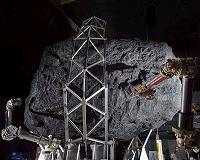
Future space exploration aims to fly further from Earth than ever before. Now, Italian Space Agency scientists have expressed an interest in contributing to the development of robotic technologies to bring an asteroid from beyond lunar orbit back into closer reach in order to better study it.
In a paper published in EPJ Plus, Marco Tantardini and Enrico Flamini from the Italian Space Agency (ASI) make the case for taking part in the robotic phase of the Asteroid Redirect Mission (ARM). In addition to taking manned spaceflights deeper into space than ever before, the proposed mission would also bring some benefit for planetary science.
Further, the mission has potential implications for a field called planetary defence. The mission could even help to validate a concept known as enhanced gravity tractor. This involves relying on a spacecraft to deflect a potentially hazardous asteroid that might impact Earth, without physically contacting it. Instead, it uses its gravitational field to transmit the required impulse.
The next step for human space exploration after the International Space Station is to send astronauts on a Near Earth Asteroid by 2025, as planned by NASA. This constitutes an intermediate step towards future manned missions to Mars. The planned ARM mission has been part of the NASA program since 2013.
The robotic spacecraft would cruise in deep space towards a near-Earth asteroid, using a technology called advanced Solar Electric Propulsion. Under the proposed plan, Italy would contribute by enhancing the carrying capacity of that spacecraft.
The robotic spacecraft would be capable of approaching the asteroid, characterising it, capturing it, and then redirecting it to a final stable orbit that would be closer to Earth and thus easier for astronauts to reach. Far space exploration is only beginning.
Florida startup boldly sets sights on moon
Florida startup Moon Express is setting its sights high: ambitiously shooting to become the first private company to launch a small, unmanned craft to the moon before the year's out.
A big success could pave the way for scheduled flights to deliver scientific and exploration equipment, to exploit lunar soil resources and commercial potential.
In a recent interview with AFP, CEO and co-fo … read more
