
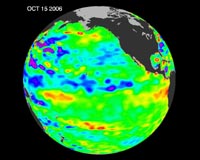
Australian forecasters said Thursday that the El Nino weather pattern blamed for the worst drought in a century had ended, and expressed cautious optimism much-needed rain was on the way. The Bureau of Meteorology said there was no guarantee the drought was over but the end of the El Nino meant there was reason to be hopeful. "The 2006/07 El Nino has ended," the bureau said in a statement.
"While the end of the El Nino would normally be associated with a return to more normal rainfall patterns, it should not be seen as a precursor to drought-breaking rains.
"Nonetheless, we can be cautiously optimistic that there will be a general easing of dry conditions in drought-affected areas over the next one to two seasons."
El Nino is occasional warming of the central and eastern Pacific Ocean that typically happens every four to seven years and disrupts weather patterns from the western seaboard of Latin America to East Africa for 12-18 months.
It has been blamed for flooding in the Horn of Africa and Bolivia, more severe winter monsoons in South Asia, and the lengthy drought in Australia.
"More often than not, El Nino events result in reduced rainfall across parts of eastern and northern Australia, particularly during winter, spring and early summer," the bureau said.
"However, the precise nature of the impact differs quite markedly from one event to another, even with similar changes and patterns in the Pacific Ocean."
The bureau said there was a higher-than-average chance of the El Nino being followed by a "La Nina" weather pattern, which occurs when the Pacific cools, offering hope of drought-breaking rains.
"La Nina events are generally associated with wetter-than-normal conditions across much of the eastern half of the country from about autumn," it said.
The bureau said El Nino was a natural phenomenon that was extremely difficult to predict. "El Nino is not a freak of climate, it's not a rogue weather phenomenon, and it isn't in any way abnormal," it said.
"Furthermore it is not a scourge, and as far as Australia is concerned, it shouldn't be thought of as a synonym for drought, although it's often linked to reduced rainfall in eastern and northern Australia.
Source: Agence France-Presse
