
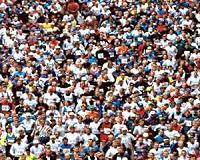
Japan's health minister on Sunday urged the public to avoid crowds and "non-essential gatherings", including notoriously packed commuter trains, to prevent the new coronavirus from spreading in the country.
Katsunobu Kato warned the nation was "entering a new phase" in the outbreak of the virus, which has infected nearly 60 people in Japan so far.
"We want to ask the public to avoid non-urgent, non-essential gatherings. We want elderly and those with pre-existing conditions to avoid crowded places," Kato said after a meeting of a panel of experts.
"I think it's important that we exercise Japan's collective strength. We wish to ask the Japanese people for their cooperation and it will take everyone being united to tackle this infectious disease," he told a press conference.
Kato said cases with no clear transmission chains and involving people who have not travelled to China, where the outbreak began, meant Japan was entering a new stage.
The government will draft fresh guidelines for doctors about when to suspect possible coronavirus infections and for ordinary citizens to know when to seek medical care.
Japan has been pushing Tokyo residents to try telecommuting or avoid rush hour commutes to ease traffic congestion during the summer Tokyo Olympic Games.
Kato said the government will reiterate its calls on people to try those measures to ease spread of the virus.
The comments come after a spate of new infections were confirmed over the weekend, raising the total number of cases inside Japan to 59.
Those numbers exclude hundreds of cases aboard a cruise ship, as well as a quarantine officer who tested people on the boat.
Most infected individuals seem to experience mild conditions similar to the common cold and may not realise that they have the disease, risking possibly spreading it to others, said Takaji Wakita, chief of the National Institute of Infectious Diseases who headed the expert panel.
"It is expected that domestic infections will continue," Wakita said, adding that Japan was at an early stage of the spread.
WHO says not advising on whether to hold Tokyo Olympics
Geneva (AFP) Feb 14, 2020 –
The World Health Organisation on Friday said it was not advising on whether or not to go ahead with the Tokyo Olympics this year amid the novel coronavirus outbreak.
But Michael Ryan, head of WHO's health emergencies programme, said the UN agency could offer technical advice on how to handle possible risks around the event.
"We have not offered advice to the IOC for the Olympics one way or the other. And neither would we, it's not the role of WHO to call off or not call off any event," Ryan said at a regular press conference in Geneva.
"It's the decision of hosting countries and the organising agencies to make that decision," he said.
The head of the International Olympic Committee (IOC) coordination commission earlier on Friday insisted there was no danger of Tokyo 2020 being cancelled or moved.
"The advice we have received from the World Health Organization is that there is no case for a contingency plan to cancel or move the Games," John Coates told reporters after a project review meeting.
Ryan explained that the UN health agency regularly offered technical advice to countries hosting all kinds of mass gatherings, such as sporting events or religious festivals.
"At this stage, there has been no specific discussion or no specific decision made regarding any of those mass events in the coming months.
"But we stand ready to offer both member states hosting events and organisations organising events to offer them the best mechanism and risk assessment approaches that we have," he said.
The COVID-19 outbreak has killed nearly 1,400 people and infected around 64,000 — most of them in China.
Two dozen countries, including Japan, have confirmed cases of the disease, which the WHO has declared a global health emergency.
Tokyo organisers have slammed "fake news" and scare-mongering over the coronavirus outbreak for causing panic ahead of the Games, which open on July 24.
