
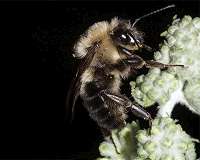
Bees can count and understand the concept of zero. But their math skills have limits.
Previously, scientists thought bees could only count to four, but new research suggests bees can understand quantities as great as five, provided they're trained with rewards and punishments.
Tests suggest fish are also thwarted by arithmetic thresholds. But it's not just small-brained animals. Human brains are similarly limited. Estimating quantities up to four is effortless for most people, but estimating larger quantities takes more concentration.
Until now, scientists thought bees were incapable of the focus necessary to comprehend larger numbers. However, the latest research showed that when bees are properly trained, they can process quantities as large as five.
For the study, scientists at RMIT University in Australia taught honeybees to associate specific symbols with specific numbers — much the way humans use numerals to represent different quantities — and to distinguish between lesser and greater values. The researchers reinforced the associations with a sugary solution, while wrong answers earned a bitter solution.
For half the test bees, scientists only rewarded correct answers. Incorrect selections earned no punishment. The other half of the test group received both rewards and punishments.
Each bee was made to fly to the end of a Y-shaped maze to make their selection and fly back to their hive to share their sugary treat.
Bees that were only rewarded failed to distinguish between four and greater values, but bees that were rewarded and punished were able to distinguish between four and larger quantities. The properly trained bees even learned that five is greater than four.
"Thus, bees' ability to learn higher number discrimination depends not just on their innate abilities, but also on the risks and rewards on offer for doing so," researchers wrote in The Conversation.
Scientists published the results of their tests this week in the Journal of Experimental Biology.
Global warming is causing moths in the tropics to shrink
Washington (UPI) Oct 11, 2019 –
As temperatures rise, vulnerable species, including insects like moths, move to higher elevations. While chasing moth species up the mountains of Borneo's national parks, scientists from the University of York realized the insects were also getting smaller.
Researchers turned to earlier surveys to confirm what their eyes were telling them. Moth surveys conducted on Borneo's Mount Kinabalu between 1965 and 2007 revealed significant reduction the length of moth wings. The analysis was detailed this week in the journal Nature Communications.
Scientists determined that the reduction in wing sizes was explained by the shrinking of moth bodies and the arrival of smaller species at higher and higher elevations.
If the changes in body size continue, entire ecosystems could be affected.
"Moths becoming smaller could have two significant impacts: It will mean on average an insect having a smaller number of eggs, which will reduce the capacity to reproduce," York biologist Chris Thomas said in a news release. "Secondly, the size of the insect will affect how much they eat and so this will affect their energy value in the food chain. If insect size changes become widespread, it could lead to functional changes across the ecosystem."
All over the world, species sensitive to temperature change are seeking refuge at higher elevations. In California, for example, pikas are climbing higher toward the peaks of the Cascade and Sierra Nevada mountain ranges. In Borne, Mount Kinabalu continues to serve as a sanctuary for plants and animals trying to escape the heat.
"The area we studied on Mount Kinabalu is a protected national park but even in a place like this, we cannot protect insect communities from climate change, which is altering biological communities and ecosystem processes," biologist Jane Hill said.
