Fourth March 1970 was a unique day in British space history when the Black Arrow rocket took to the sky from a launch pad in Australia. The successful launch still represents the only British rocket to carry a satellite into space.
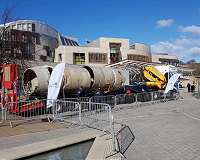
British rocket launch provider Skyrora, the UK Space agency and The Farnborough Air Sciences Trust (FAST), have partnered to celebrate the 50th anniversary of this accomplishment and more recent achievements of the UK space sector. To mark the occasion, the FAST Museum supported by its new partner, Skyrora, will exhibit the first stage of Black Arrow. After spending over forty-eight years in the Australian outback, Skyrora brought the rocket back home two years ago. Moving it from its home in Penicuik, Midlothian, Scotland the company has lent the historic exhibit to the FAST Museum for three years.
This new and impressive exhibit is presented in the authentic condition in which it survived launch recovery and is in stark contrast in the museum's Cody Pavilion opposite a full-size replica of Britain's first successful piloted, powered flying machine, British Army Aeroplane No 1A.
Volodymyr Levykin, chief executive officer of Skyrora said: "Today, we mark the 50th Anniversary of the UK's Access to Space. The Black Arrow programme was the foundation of the future of UK space exploration. It showed proven technology and is the British heritage of space in the UK."
Richard Gardner, chairman of FAST, said: "This significant addition to our own display of space satellites, systems and innovations that all came from the former RAE at Farnborough, should attract much interest, especially from young people, as we encourage the next generation to participate in the exciting new space era that Skyrora is helping to re-establish in the UK."
Skyrora aims to be the first UK-based company to fire a rocket, similar in its core propulsion system to the innovative Black Arrow, into space from Scotland. Their plan is to launch smallsats into polar orbit. Last month, the company completed a week of test of its 3D-printed 3.5kN LEO engine, which will be used to power the final upper stage of its 22-metre tall XL rocket and its high grade fuel Ecosene.
Developed by Skyrora, Ecosene converts waste plastics that otherwise would be disposed of in landfill or in oceans into the greener, more socially-responsible fuel source. The tests followed last year's successful launch of Skyrora's second small rocket, providing proof of reusability – the two-meter-long Skylark Nano II.
"The exhibit of the Black Arrow R3 at the FAST Museum together with our renewed launcher programme is a very exciting development," said Volodymyr Levykin, "It is highly appropriate that Farnborough is in the spotlight, to inspire the younger generation and general public.
"New technology is reducing the cost of access to space and with the added efforts by the government I see an opportunity for Skyrora and the UK to thrive in this commercial space age."
Emma Floyd, director of commercial spaceflight at the UK Space Agency said: "Our aim is to establish commercial vertical and horizontal satellite launch from UK spaceports – providing world-leading capability, bringing new markets to the UK and inspiring the next generation of British space scientists, engineers and entrepreneurs. Black Arrow is an important part of the UK's space heritage, and it is great to be able to recognise the achievements of the past as we look to the future."
Black Arrow
Black Arrow is of great historical and technical importance playing a pioneering role during the late 1960s and early 1970s in placing the first British designed and built space satellite into Earth orbit.
The programme grew from earlier UK space research and development programmes undertaken by the Royal Aircraft Establishment (RAE) at Farnborough, which included designing and building in conjunction with industry, a series of launch vehicles and their rocket engines, along with all the associated ground-based infrastructure, including assembly and test facilities in the UK and a launch complex with control and range facilities at Woomera, Australia.
The intension was to see if a rocket, capable of launching satellites into space, could be developed from existing technologies, for example HTP/kerosene powered engines developed in the UK. Much like the approach Skyrora is taking today.
The Black Arrow programme developed four rockets between 1969 and 1971. Black Arrow was a three-stage rocket, thirteen metres tall, with a single eight-chambered engine in its first stage. The third stage for Black Arrow was a solid rocket motor manufactured by RPE Westcott.
The first stage of Black Arrow R3, the surviving launcher that was used to place the Prospero satellite into orbit in 1971, has been brought back to the UK by Skyrora and is now on public display at the Farnborough Air Sciences Trust Museum, close to the original programme birthplace, the RAE Space Department.