
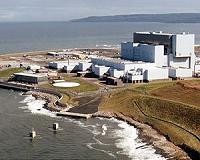
Britain on Tuesday agreed to provide a financial guarantee to a Franco-Japanese joint venture which is seeking to build Europe's largest new nuclear power development in the country.
NuGeneration Limited, a venture between France's GDF Suez and Japan's Toshiba, has signed a cooperation agreement with the government to promote financing for the new nuclear plant project in Moorside, West Cumbria, it said in a statement.
Tuesday's announcement is part of a national infrastructure investment plan unveiled before the government's budget update, which will be delivered by finance minister George Osborne on Wednesday ahead of next year's general election.
The government is controversially pushing ahead with new nuclear power projects in a major boost to an industry brought to its knees by the 2011 Fukushima disaster in Japan.
The EU in September recommended approval of Britain's ambitious plan to build its first nuclear plant in a generation — the Hinkley Point project — with backing from French and Chinese energy giants, after ruling that it met state aid rules.
Under the Moorside project, NuGen will build three Westinghouse AP1000 reactors on land to the north and west of the existing Sellafield nuclear reprocessing plant.
Moorside includes 2.3 billion pounds ($3.6 billion, 2.9 billion euros) of investment in flood defences and 15 billion pounds of road improvements.
"We're happy to have signed this agreement with NuGen," Osborne said in Tuesday's statement.
"Investment in a new generation of civil nuclear power is part of our long term economic plan to provide Britain with the energy it needs for decades to come."
He added: "The guarantee scheme is another way in which we can help companies to make the huge investment that building new nuclear power involves."
The first reactor is expected to be connected by the end of 2024.
Britain currently has 16 reactors which provide about 20 percent of the country's energy needs and London is placing nuclear power at the heart of its low-carbon energy policy.
This is in stark contrast to Europe's biggest economy Germany, which vowed to phase out nuclear power in the wake of the Fukushima, the worst atomic disaster since Chernobyl.
More than three years after the disaster, where a tsunami sent reactors into meltdown, global opinions remain deeply divided on the safety of the nuclear technology.
