
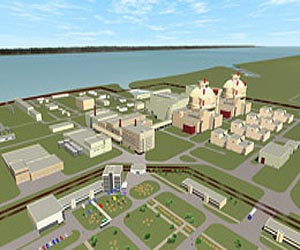
Bulgaria has decided to drop a deal with Russian company Atomstroyexport to build a 2,000-megawatt nuclear power plant on the Danube, Prime Minister Boyko Borisov said Wednesday.
"Today the government took a decision to end the Belene nuclear power plant) project," Borisov told journalists after informing parliament of the decision.
Bulgaria contracted Atomstoyexport in 2008 to build two new 1,000-megawatt reactors at Belene, with the Russian company recently saying it would have the first one ready by October.
Borisov said Wednesday, however, that the government could not afford to pay the plant's estimated price of about 6.0 billion euros ($8 billion) plus interest on eventual credits it would have to take to fund the deal.
"It is not possible for us to pay and oblige generations of Bulgarians to pay this money. It can't be done," he said.
The initial contract priced the project at 4.0 billion euros plus inflation, with the end price always unclear.
The project has lagged for years, dogged by constant price-haggling with Russia and a failure to find a new Western investor after the withdrawal in 2009 of German utility RWE.
Borisov said dropping the deal was "a hard decision" but also called the project "an absolute failure."
Bulgaria has already paid 1.4 billion euros ($1.9 billion) to Atomstroyexport and owes French bank BNP Paribas another 500 million euros on a Belene credit line, he said.
The government will pay the Russian company the remaining 100 million euros for the soon-to-be completed first reactor, and will install it at its nuclear power plant in Kozloduy — eliminating the need for additional infrastructure, Borisov added.
Meanwhile, the government was looking into the possibility of constructing a gas-fired power station on the Belene site, instead of the nuclear plant, he added.
Borisov discussed Belene's fate with Russian president-elect Vladimir Putin on Monday and will send Economy and Energy Minister Delyan Dobrev to Moscow Thursday to try to persuade the Russian contractor not to take Bulgaria to court over its decision to drop the deal.
Bulgaria, a top electricity exporter in the Balkans, currently has two 1,000-megawatt reactors in operation at Kozloduy, also on the Danube.
The initial thinking behind the Belene plant was to compensate for lost capacity after Brussels demanded the shutting of four smaller Kozloduy units over safety concerns on the eve of Sofia's European Union accession in 2007.
