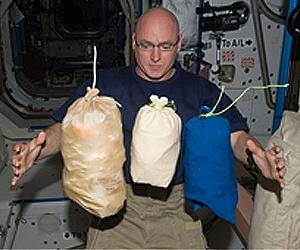
Commander Scott Kelly sent down congratulations to the SpaceX team after Mission Control informed him of the Falcon 9's successful launch into orbit Wednesday morning. This was the first demonstration flight of the commercial spacecraft designed with the goal of carrying humans into space.
Kelly continued work with the Capillary Flow Experiment. He set up a camcorder and lighting gear that captures video of fluids in a chamber behaving under various conditions. Results will help engineers design more advanced microgravity fuel delivery systems and fluid storage facilities.
An electronics unit failed on a science storage freezer Tuesday night. The biological samples stored in the freezer were safely removed by Kelly and placed in a secondary freezer. Both freezers are identical and officially called the Minus Eighty Degree Laboratory for International Space Station 1 and 2 (MELFI-1 and MELFI-2).
The commander also talked to reporters from KTRK-TV in Houston and ABC News Radio. Kelly discussed the upcoming arrival of three new crew members and holiday plans on the station.
Flight Engineers Alexander Kaleri and Oleg Skripochka worked in the Russian segment of the orbiting laboratory Wednesday. The cosmonauts cleaned fan guards and set up a communications panel inside the Zarya control module.
At the Cosmonaut Hotel in Baikonur Cosmodrome, Kazakhstan, a new trio of Expedition 26 flight engineers continued to prepare for their launch to the International Space Station. Catherine Coleman, Paolo Nespoli and Dmitry Kondratyev will launch on the Soyuz TMA-20 spacecraft on Dec. 15 (Dec. 16, Baikonur time) for a docking to the station two days later.
During his stay aboard the station, Kelly will post some of his photographs of Earth on Twitter for an online geography trivia game.
NASA managers have targeted the launch of space shuttle Discovery's STS-133 mission to the station for no earlier than Feb. 3.
During Discovery's final spaceflight, the STS-133 crew will deliver the Permanent Multipurpose Module, which will be attached to the Earth-facing side of the Unity module. Discovery also will carry critical spare components, the Express Logistics Carrier-4 and Robonaut 2, the first human-like robot in space.
Share This Article With Planet Earth