
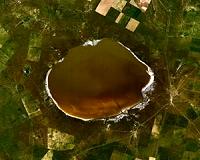
U.S. satellite imagery suggests a salt lake in Russia is being starved of its sediment, causing it to appear brighter and brighter over time.
Lake Elton — which stretches some 60,000 square miles but never gets deeper than two feet — is located in Volgograd Oblast, Russia, near the Kazakhstan border. It's one of the biggest, saltiest lakes in Europe. It's also, when seen from 400 miles up, one of the brightest geological features in the region.
Elton's salt-crusted lakebed is like a pale-yellow mirror for the sun's rays. Juxtaposed by the surrounding dead brown landscape, the oblong sheet of water is almost blinding from the vantage of Landsat 8, one NASA's Earth Observatory satellites. And apparently, that eye-stinging contrast is getting starker.
Scientists measure an object's reflectivity, or albedo, on a scale of 0 to 1 — 0 being the least reflective and 1 being the most reflective. According to imagery captured by Landsat 8, Elton's max albedo in 2004 was 0.14. In 2009, it was 0.4, a drastic change for such a small window of time.
Now, researchers suggest newly installed dams are to blame for the salt lake's ongoing brightening.
The lake has been home to a spa for more than a century. But in 2005, when severe flooding nearly wiped out the spa, as well as a nearby sanitorium, the government agreed to install dams to control the amount of water flowing into the lake.
The dams, however, don't just prevent water from flowing freely, they also stop sediment dead in their tracks. Less sediment means clearer water. And clearer water means the sun's ray bounce more easily off Elton's naturally reflective lakebed.
That's bad news for ISS astronauts who left their sunglasses back on Earth. But it's also bad news for the spa. With less sediment, there's also less mineral-rich mud — mud which the spa relies on to treat its patients' skin disorders.
Anatoly Zeiliguer — a hydrologist at Moscow State University who has studied the effects of the lake's stymied sediment supply — says the lake's condition is a reminder to resource management officials to always think (and think so more) before meddling with nature.
"Our study clearly shows that it is most important to understand the hydrological system prior to intervening and drastically altering the dynamics of a fragile system such as a salt lake," he and his colleagues wrote in 2012.
