
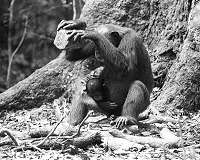
New research suggests that when chimpanzees are performing more complex tasks, they are more likely to share tools with their more novice peers and offspring, as well as engage in teaching behaviors.
Scientists have previously noted that tool-sharing among chimpanzees represented a form of teaching, but that chimps learn primarily through watching and mimicking — not via direct teaching.
"Non-human primates are often thought to learn tool skills by watching others and practicing on their own, with little direct help from mothers or other expert tool users," Stephanie Musgrave, assistant professor of anthropology at the University of Miami, said in a news release. "In contrast, the results from this research indicate that social learning may vary in relation to how challenging the task is: during tasks that are more difficult, mothers can in fact play a more active role, including behaviors that function to teach."
For the new study, scientists used standardized methods to track how cultural transmission differed among two groups of wild chimpanzees, a first.
The two populations — one in the Goualougo Triangle, Republic of Congo, the other in Gombe, Tanzania — use tools to target the same resource, termite ants. Both use fishing pole-like sticks to retrieve termites from their complex nests, but the Goualougo chimpanzees use a sophisticated array of tools in sequential order.
Researchers found the rate of tool transfer is three times greater among the Goualougo population. Mother chimps at Goualougo were also observed actively responding to the tool requests of their offspring, a behavior not found among Gombe chimps.
"We have previously documented that tool transfers at Goualougo function as a form of teaching," said Crickette Sanz, associate professor of biological anthropology at Washington University. "The population differences we observed in the present study suggest that teaching may be related specifically to the demands of learning to manufacture tools at Goualougo, where chimpanzees use multiple tool types, make tools from select plant species, and perform modifications that increase tool efficiency."
The new research, detailed this week in the journal PNAS, offers one of the best examples yet of prosocial behavior, or helping behavior, among wild chimpanzees.
By studying prosocial behaviors and the transfer of cultural or technological knowledge among generations of chimps, scientists can begin to understand the origins of more complex cultural abilities among early humans.
"Human evolution is characterized by the emergence and elaboration of complex technologies, which is often attributed to our species' aptitude for passing skills onto one another through mechanisms such as teaching and imitation. However, the evolutionary origins of these capacities remain unclear," Musgrave said. "Our research shows that the human propensity to assist others in acquiring complex skills may build at least in part upon capacities that we share with our closest living relatives."
