
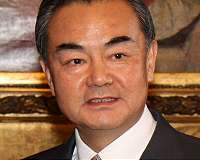
China's foreign minister on Tuesday slammed the US for "reckless provocation of confrontation" after both sides ordered tit-for-tat closures of each other's consulates, but called for "rational communication" between the two powers.
Wang Yi warned in a call with his French counterpart Jean-Yves Le Drian that China-US relations could "fall into the abyss of confrontation", according to a transcript published by the Chinese foreign ministry.
He also called for the international community to resist "any unilateral or hegemonic act", it said.
Relations have deteriorated in recent weeks in an intensifying standoff between Washington and Beijing, with the US mission in Chengdu ordered to shut on Monday in retaliation for the forced closure of the Chinese consulate in Houston, Texas.
"The US reckless provocation of confrontation and division is so out of touch with the reality that the interests of China and the United States are deeply integrated," Wang said.
But the two sides should "engage in rational communication" and "never allow a few anti-China elements to overturn decades of successful exchanges and cooperation", he added.
– 'Ghost of McCarthyism' –
Chinese officials took over the premises of the US consulate in Chengdu on Monday, while the last Chinese diplomats left the consulate in Houston on Friday, with both sides alleging the other had endangered national security, in the latest tit-for-tat blows exchanged by the rivals.
Trump's administration has ramped up pressure on China on a wide range of issues, imposing sanctions over policies in Tibet and Xinjiang, where an estimated one million Uighurs and other ethnic minorities are believed to have been rounded up and held in re-education camps.
The United States has also downgraded relations with Hong Kong after China implemented a new security law which Washington says is in violation of Beijing's promises of autonomy for the territory.
Disputes between the two sides over a host of other issues ranging from blame for the COVID-19 pandemic to state-run media have resulted in the expulsions of journalists from both countries as well as sanctions against top officials.
The US has also in recent weeks declared China's geopolitical claims in the South China Sea fundamentally illegal, and sent two aircraft carriers to that region to underscore the point.
US Secretary of State Mike Pompeo called on Thursday for the "free world" to triumph over what he said was a "new tyranny" from China, implying that former US President Richard Nixon's move to normalize relations with China in the 1970s was a mistake.
Wang in turn said on Tuesday that the US had become "the biggest perpetrator to destroy the current international order," and called Pompeo's remarks a sign of "the ghost of McCarthyism coming back from the ashes."
EU to restrict exports to Hong Kong over security law
Brussels (AFP) July 28, 2020 –
The European Union on Tuesday agreed to limit exports to Hong Kong of equipment that could be used for surveillance and repression after Beijing imposed a controversial new security law.
The bloc voiced "grave concern" over the new law, saying it would severely erode freedoms in Hong Kong that were supposed to be protected under the terms of its handover from Britain to China.
The EU has struggled to agree a united response to China. Member states deeply divided over whether to stand up to Beijing — a hugely important trading partner — or to try to cooperate with it.
But following a proposal by France and Germany, the 27 member states on Tuesday agreed to limit exports to Hong Kong of technology that could be used for "internal repression, the interception of internal communications or cyber-surveillance".
"The EU considers the national security legislation for Hong Kong… to be a matter of grave concern," said a statement from the EU council, where all member states' leaders have a seat.
"The EU is particularly concerned about the extensive erosion of rights and freedoms that were supposed to remain protected until at least 2047."
Along with the export restriction, the EU will also bring in measures to support the population of the former British colony, granting visas, scholarships and academic exchanges to make it easier for them to travel to Europe, diplomats said.
German Foreign Minister Heiko Maas said that with the new security law in place, "It makes sense to treat Hong Kong no differently from mainland China" when it comes to the export of equipment that can be used for repression.
Beijing on Tuesday announced the suspension of extradition treaties with Canada, Australia and Britain, following similar moves by those countries over the new law.
Hong Kong's former colonial ruler Britain suspended its extradition treaty last week saying the security law had "significantly changed key assumptions" including a provision to try certain cases in mainland China.
Beijing insists the security law is needed to restore stability in the financial hub after prolonged political unrest.
