
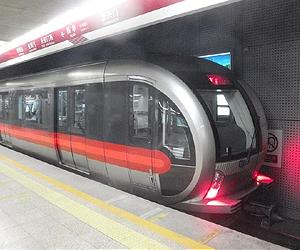
China's rail and train builders, who gained valuable experience at home in projects with Western heavyweights, are now competing with them for global contracts, but analysts say a lack of international savvy could clip their ambitions.
China already has 8,300 kilometres (5,150 miles) of high-speed rail and from next year will boast more than half of the world's fast tracks.
The country is also pouring money into its urban underground networks, with nearly two dozen major cities given the green light in late 2009 to build 89 metro lines by 2016 — at an estimated cost of 880 billion yuan ($134 billion).
Train constructors China Northern Railway (CNR) and China Southern Railway (CSR), along with China Railway Group and China Railway Construction Corp Ltd., are now confidently battling — and earning the respect of — industry giants Alstom, Bombardier and Siemens, from whom they acquired significant technology.
Chinese firms gained the rights to use certain rail technology when they bought equipment from Western firms, which they went on to modify.
China says its products are the result of homegrown innovation, but some foreign executives complained in the past that technology meant for domestic use is now being used — unfairly — in products for export
"The very strong growth in the Chinese market will continue over the next decade but it will henceforth be focused on overseas markets," the president of French group Alstom's China division, Dominique Pouliquen, told AFP.
"The tech transfer issue is no longer relevant. The Chinese have acquired a lot of experience and have lots of engineers, which allows them to make up any (technological) delay in 18 months to two years," Pouliquen said.
His counterpart for Canada's Bombardier, Zhang Jianwei, agreed.
"Both CSR and CNR have grown very rapidly, benefiting from the rapid development of the Chinese railway and urban mass transit markets, and they are becoming important players in the field worldwide," he told AFP.
In December, US conglomerate General Electric signed a deal with CSR to manufacture high-speed trains in the United States — a project President Barack Obama sees as key to rebuilding US competitiveness and creating jobs.
Only a few months before, during a September visit to Shanghai, then California governor Arnold Schwarzenegger raised eyebrows when he said he hoped China would invest in his state's future high-speed rail network.
And in Britain, CSR is reportedly in the running to win a contract for 120 high-speed trains, which the firm would initially loan out to diminish costs, according to the 21st Century Business Herald, a Chinese financial newspaper.
"According to our strategic development plan, our turnover should hit 150 billion yuan in 2015, which would make us the world's number one manufacturer of rail transport equipment," CSR said in a statement to AFP.
"CSR is in the process of speeding up its internationalisation," said the firm, adding that it expected overseas sales to account for 20 percent of its turnover in 2015.
Experts say however that China's key players in the sector have a long way to go before they can best their French, Canadian and German rivals.
"CSR and CNR have made major progress, but they only currently have a stake in about five percent of the global market," Li Xuerong, an industry analyst at CIConsulting in the Chinese city of Shenzhen, told AFP.
Frederic Campagnac, a Beijing-based transport and logistics expert, said the Chinese firms would hit obstacles as they expand their reach.
"The Chinese train and rail manufacturers have acquired significant know-how thanks to the domestic market, but they are untested abroad. It's very difficult for a Chinese company to work in a non-Chinese setting," he said.
Li said Chinese firms undoubtedly prefer to work on their own rather with local partners — a strategy that is easier to achieve in developing countries than in major economies with a homegrown rail industry.
This year, construction will begin on a rail link across Laos that will connect China to Thailand and the rest of Southeast Asia.
Earlier this month, a state-run Iranian firm signed a $13 billion deal with China to build a 5,300-kilometre railway network in the Islamic republic.
In Africa, where China built a railway linking Tanzania and Zambia in the 1970s, Chinese firms have more recently worked to refurbish the rails in Angola and won approval to build a rail line in Sudan.
Share This Article With Planet Earth
