
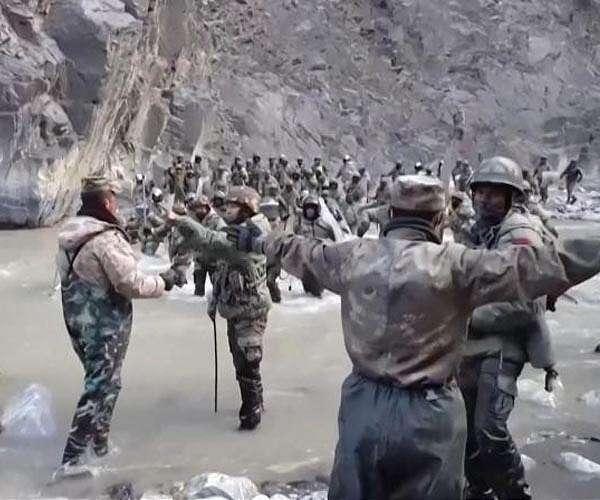
Dramatic footage released by Chinese state media purportedly shows deadly clashes between troops at the Indian border last year — a rare insight into violence at the tense, remote frontier.
China's defence ministry on Friday named four soldiers killed in the brawl, in the first confirmation of deaths by Beijing from an incident that also claimed the lives of at least 20 Indian soldiers.
Footage later released by state broadcaster CCTV appeared to show Indian troops wading through a river towards Chinese soldiers in the barren and ice-covered Karakoram Mountains, carrying sticks and shields reading "Police".
A bilateral accord prevents the use of guns by either side, and brutal clashes between the two sides on the ill-defined border often involve sticks, rocks and fist-fights.
"They have now moved another new tent here," one soldier says in the video, which claims the Indian side broke the consensus and crossed the line to "provoke" Chinese soldiers.
Later footage shows a large melee of troops from both sides and clashes in the dark, before Chinese soldiers are seen treating a man on the floor whose head is covered in blood.
The high-altitude border battle in the Galwan valley in June was one of the deadliest clashes between the two sides in recent decades.
Beijing acknowledged that the clash had resulted in casualties but did not confirm if any Chinese soldiers died until this week.
The CCTV voiceover said the Chinese soldiers were "heroically sacrificed".
Battalion commander Chen Hongjun and three other soldiers have been given posthumous awards, the defence ministry said. State media reported that the youngest soldier to die was 19.
India and China fought a border war in 1962 and have long accused each other of seeking to cross their frontier — which has never been properly agreed — in India's Ladakh region, just opposite Tibet.
Beijing and New Delhi later sent tens of thousands of extra troops to the border, but said last week they had agreed to "disengage" along the border area.
China confirms four died in June clash on India border
Beijing (AFP) Feb 19, 2021 –
China's defence ministry on Friday named four soldiers killed in a brawl with Indian forces last year, the first confirmation of deaths by Beijing from the border clash that also killed at least 20 Indian soldiers.
The Chinese soldiers "sacrificed themselves" during the June confrontation in the contested Galwan Valley border area with Indian troops, the ministry said.
India and China fought a border war in 1962 and have long accused each other of seeking to cross their frontier — which has never been properly agreed — in India's Ladakh region, just opposite Tibet.
In mid-June, 20 Indian soldiers were killed in a brutal, high-altitude border battle in the Galwan valley in one of the deadliest clashes between the two sides in recent decades.
Beijing at the time acknowledged that the clash had resulted in casualties but did not confirm if any Chinese soldiers died.
Battalion commander Chen Hongjun and three other soldiers have been given posthumous awards, the defence ministry said.
It blamed the battle in June on "foreign troops blatantly violating the consensus reached with us and crossing the line to set up tents".
It said Chinese troops were able to drive their adversaries away in a "significant victory", and that the Indian side "ran away with their heads in their hands, abandoning numerous border-crossing and injured or dead personnel".
Beijing and New Delhi later sent tens of thousands of extra troops to the border.
China's foreign ministry on Friday said Beijing had released the details to show "truth and facts".
"India has repeatedly exaggerated and hyped up the relevant issue of deaths, and distorted facts to mislead international public opinion," foreign ministry spokeswoman Hua Chunying said.
It is unclear if China suffered any other casualties during the clash.
The two sides said last week they had agreed to "disengage" along the border area.
Indian Defence Minister Rajnath Singh said the agreement would "substantially restore the situation to that existing prior to commencement of the stand-off last year".
