
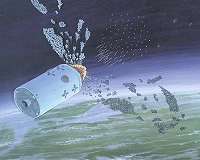
There has been a great deal of media coverage regarding orbital debris and its possible removal. As it turns out, there is some good news and some bad news about space debris in general. The good news is intended for would be entrepreneurs. Orbital debris can be thought of as a growth industry, just as trash removal and waste management have become large industries. Earthbound humans need and accept these services as necessary and desirable. And, most people agree that the costs are affordable.
When it comes to eliminating orbital debris, there are similarities to earth-bound trash removal. Both types of trash are at least undesirable and, at most, require removal. I think we can agree that ordinary trash and waste present serious health hazards for the general population. So, removal is assumed to be essential. Fortunately, eliminating human waste is relatively easy and inexpensive as compared to orbital debris removal.
If you believe recent popular-media articles, it appears that removing of such debris is straightforward and many international organizations are proceeding to build relatively simple systems that will travel around near-earth space and collect orbiting junk, much like a garbage truck collects your trash. However, this image is far from reality.
For example, building any spacecraft that can collect anything is a major and expensive undertaking. We are talking about possibly spending hundreds of millions of dollars just for a maneuvering collection satellite. Add to this the cost of launch and operations.
As a result, the cost of collecting a single expired satellite can be as much as, or more than, placing a new operating satellite in orbit. This realization begs the question: "Who is going to pay for collecting space trash?" At the moment, the answer is: No one.
Another important question is: "Who should pay for cleaning up space?" The natural response is that the countries creating the mess should pay. The worst offenders are Russia (and former Soviet Union), China, European countries and the USA.
Logically, these countries should pay a major portion of the expense. Every one of these countries is painfully aware of the situation, but none have volunteered to contribute to the cleanup. And, they are not going to offer any serious funding level for this activity. They are going to continue to "kick this trash can down the road."
Ultimately, the space trash problem will "snowball" into a major space obstruction which may well block all use of space for exploration and exploitation. As a result, the most important question is: "At what point must spacefaring nations undertake serious, sustained remedial actions to keep space accessible for its many critically important applications?
