
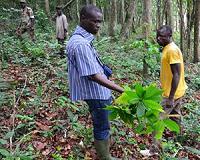
Major chocolate makers, including Ferrero, Nestle and Mars, agreed Thursday a landmark initiative to tackle deforestation in top cocoa producers Ivory Coast and Ghana — a move hailed by Prince Charles.
Twelve cocoa and chocolate companies agreed to "a statement of collective intent" committing them to work to end deforestation and forest degradation in the global cocoa supply chain, with an initial focus on the two west African nations, the industry announced following a London meeting hosted by the British heir to the throne.
"The agreement… commits the participating companies to develop and present a joint public-private framework of action to address deforestation" at UN climate talks in November, said a joint statement.
The prince told a conference that "the most powerful direct reason for action is that deforestation threatens to undermine the very resilience of the cocoa sector itself, and with it the livelihoods of the millions of smallholders who depend on it".
"I am heartened that companies are undertaking to work up, in full collaboration with host governments and civil society, a joint framework of action to make good on the commitments announced today, in time for" the UN climate change conference in November.
The World Cocoa Foundation (WCF), which held the meeting with the Sustainable Trade Initiative and Charles' International Sustainability Unit, described the agreement as "the first collective industry commitment to specifically end deforestation and forest degradation covering the global cocoa supply chain".
The dozen companies involved in the initiative comprise also Barry Callebaut, Blommer Chocolate Company, Cargill, CEMOI, ECOM, Hershey, Mondelez, Olam and Touton.
"We look forward to more companies joining the effort and are grateful for the leadership provided by The Prince of Wales in convening today's landmark event," said WCF chairman Barry Parkin.
bcp/rl
BARRY CALLEBAUT
OLAM INTERNATIONAL
MONDELEZ INTERNATIONAL
NESTLE
What makes farmers try new practices?
Change is never easy. But when it comes to adopting new agricultural practices, some farmers are easier to convince than others. A group of researchers at the University of Illinois wanted to know which farmers are most likely to adopt multifunctional perennial cropping systems–trees, shrubs, or grasses that simultaneously benefit the environment and generate high-value products that can be har … read more
