
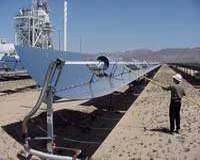
Desert Energy Development has announced that it is nearing construction of its first renewable energy electrical generation facility in the Phoenix area. This announcement is in response to the recent request by Arizona Public Service for guidance from state regulators and industry experts about the types of facilities to plan for and construct.
"We have been aware of the potential shortage of generation capacity in Arizona for some time," stated Joe Blankenship, CEO of Desert Energy. "Our studies indicate similar potential shortages stated in the APS request for guidance," continued Mr. Blankenship.
Mr. Blankenship provided the following description of Desert Energy generation capabilities: "Our Company has two unique technologies that can add to the electricity supply in Arizona. The first is a low-head hydro generation capability that can be installed in aqueducts and canals so prevalent in the West. A site near Phoenix has been selected, equipment ordered and the civil structure is being designed.
The initial site is 20 kW capacity, with rapid scaling to 100 kW, 500 kW and multi-megawatt capabilities. While our first installations will be distributed generation type facilities in aqueducts and irrigation canals, we have the opportunity to participate in two projects approaching 50 megawatts each within the lock-and-dam system on the Mississippi river, where our partner has preliminary permits.
"Our second technology combines binary cycle equipment used in geothermal installations with a unique solar thermal collection technique. This design reduces plant footprint and takes advantage of Arizona's excellent sunny conditions. This design will start at approximately 250 kW capacity and is scalable to multi-megawatt proportions.
"With the best sun conditions in the world, I am disappointed that Arizona has not provided the incentives that stimulated an explosion of photo-voltaic installations in Japan, Europe, California and New Jersey," stated Mr. Blankenship. "One Phoenix headquartered company, First Solar, has been a beneficiary of that explosive growth. Our technologies can be successful without subsidies or incentives as long as we get close to Arizona retail electric rates," continued Mr. Blankenship.
"We applaud APS's description of the magnitude of a potential shortage which might inspire the Arizona Corporation Commission and Legislature to further action," he concluded.
