
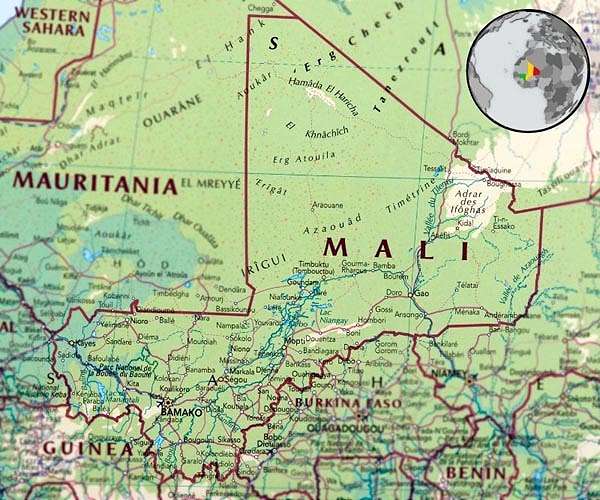
Mali's military has killed at least 34 people and disappeared 16 or more during recent operations in the war-torn centre of the Sahel state, Human Rights Watch (HRW) said Tuesday.
The rights group made the allegations in a report based on dozens of interviews testifying to massacres and beatings allegedly committed by security forces in several towns and villages in central Mali between October 2020 and March.
The region has become the epicentre of a jihadist insurgency which first emerged in northern Mali in 2012 before spreading to the centre and neighbouring Burkina Faso and Niger.
Jihadists and soldiers are often blamed for abuses against civilians in the brutal conflict, which has killed thousands of people and displaced hundreds of thousands more.
The HRW report said that soldiers blindfolded and "severely beat" dozens of passengers on a bus in the town of Boni on March 23 over suspicious material allegedly found in the baggage compartment.
At least 13 of those passengers have been "disappeared", the report said.
In October near the village of Libe, according to the report, soldiers killed 25 people, many of whom were trying to flee.
Overall, the report said at least 34 people were killed and 16 forcibly disappeared between October and March in the poor Sahel country.
"Mali's security forces have shown scant regard for human life during recent counter-terrorism operations," Corinne Dufka, HRW's Sahel director, said in the report.
"Committing serious abuses in the name of security only fuels recruitment into abusive armed groups and undermines trust by local populations," she warned.
HRW said that the latest alleged abuses had occurred since the military deposed president Ibrahim Boubacar Keita in a coup in August.
It added that the interim government has pledged to investigate the findings.
Dufka said however that the Malian authorities had "failed to make good on many previous such commitments".
Rights groups regularly accuse Sahel armies of indiscriminate rights abuses.
In late December, UN investigators accused Malian security forces of war crimes, and jihadists and other armed groups of crimes against humanity.
Ivorian soldier injured in attack on military camp
Abidjan (AFP) April 21, 2021 –
Gunmen injured an Ivorian soldier in an overnight attack on a military camp near the economic capital Abidjan that left three assailants dead, the army said Wednesday.
At around 1:00 am (0100 GMT), the gunmen "opened fire on guard posts at the N'dotre military base in the town of Abobo" north of Abidjan, a statement said.
Citing a provisional toll, it said one Ivory Coast soldier was "slightly wounded", while "on the enemy side three were killed and one was injured and taken prisoner".
The assailants had the "clear intention of penetrating by force," said the statement by army chief of staff General Lassina Doumbia.
It said mopping-up operations were underway.
A security source earlier told AFP that "detonations were heard at the Anonkoua Koute military camp", referring to N'dotre by its former name.
The attack was led by a group of individuals in a black 4×4 and taxis, the source told AFP, requesting anonymity.
He said a manhunt was under way for the assailants.
The injured gunman is in custody and receiving care, he said.
A Liberian passport and driving licence were found on two of the assailants who were killed, according to security sources.
The Ivorian armed forces were placed on alert Tuesday throughout the country "due to the risk of action by subversives," the sources said.
UN Secretary General Antonio Guterres was very concerned by the attack, his spokesman said.
Photos circulating on social media showed the bodies of three civilians at the feet of soldiers.
The N'dotre base houses soldiers trained to join UN peacekeeping operations in the troubled West African country.
The attack on the military camp came three weeks after suspected Islamist militants killed three members of Ivory Coast's security forces in attacks on the country's border with jihadist-torn Burkina Faso.
No group has claimed responsibility for those attacks.
Security experts have long warned that the jihadist campaign in the Sahel, which sprang up in northern Mali in 2012 before advancing into Niger and Burkina Faso, could spread into countries on the coast of the Gulf of Guinea.
