
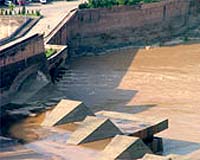
Vietnam faces power shortages this summer because water levels in hydro-electric dams have fallen sharply, authorities warned Wednesday, as meteorologists reported record-high temperatures. Vietnam is headed for a shortfall of nearly one billion kilowatt hours of electricity this dry season, said state-run Electricity of Vietnam, predicting that the country will be forced to buy power from neighbouring China.
The water level in the northern Hoa Binh reservoir is now one metre (three feet) below where it was a year ago, and the volume is at only 80 percent of last year's storage, said the National Load Dispatch Centre.
"International stations have also forecast that drought may increase this year, leading to water and then power shortages," said Quan Duc Hai, an official with the government-run centre.
"We will have to limit the use of power for people's domestic consumption. We have to call on the people to save electricity."
The warnings came as northern Vietnam recorded its mildest February in a century, with average temperatures two to five degrees Celsius (35-41 degrees Fahrenheit) above normal levels, said the Central Hydrometeorology Centre.
After a mild January, average lows in February have been around 17 degrees and highs around 30 degrees Celsius in what should be chilly winter months.
"Central and northern Vietnam recorded the highest February temperatures in a century," said Nguyen Huu Hai, head of long and medium-term forecasting. "Hanoi tops the list with temperatures five degrees above normal."
Meteorologists also warned that over the next six months Vietnam would face continued low rainfalls and higher temperatures, and the worst drought since 1987 due to the influence of the El Nino climatic phenomenon.
The World Bank warned this month that Vietnam in future faces "potentially catastrophic" consequences if man-made pollution speeds up the melting of the world's glaciers and ice caps, raising the world's sea levels.
With a population of 84 million, Vietnam has over 3,200 kilometres (2,000 miles) of coastline and concentrates its population and food production in the low-lying Mekong and Red River deltas.
The World Bank warned that global warming is a serious threat and said a sea level rise of five metres would affect 16 percent of Vietnam's land area, 35 percent of its population and 35 percent of its gross domestic product.
Even a one metre sea level rise would inundate most of Vietnam's land southwest of the largest urban centre and commercial hub of Ho Chi Minh City, affecting over 10 percent of the country's population.
Source: Agence France-Presse
