
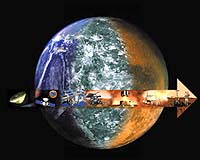
Members of the European Space Agency face a looming tough decision over whether to cut back a planned unmanned mission to Mars or stump up extra cash, ESA Director General Jean-Jacques Dordain warned on Wednesday. The ExoMars mission entails sending a 200-kilo (440-pound) wheeled rover, which will carry a drill enabling it delve up to two metres (seven feet) below the surface to see if the Red Planet has microbial life, or the potential for it.
ExoMars was initially planned for launch in 2011, but this date has already been postponed by two years to help resolve what its goals should be.
In a New Year's meeting with the press here, Dordain said the rover was over-burdened with instruments compared with the launch capability of the Russian Soyuz rocket that has been contracted to take it aloft.
ESA members will either have to lose some of the instruments so that the rover can be launched by a Soyuz, or opt for a bigger launcher, which will cost more money, he said.
In 2005, ESA members earmarked 650 million euros (838 million dollars) for ExoMars.
Dordain added there remained a question mark about how to get the precious data from the rover back to Earth.
He said he was "not 100-percent sure" that a NASA orbiter swinging around Mars would be able to act as a relay, and this raised the question as to whether a European craft would be needed to play the linking role.
"There's no point launching ExoMars if you then find that you don't have a communications link," Dordain pointed out.
Turning to US President George W. Bush's scheme to revived manned missions to the Moon, Dordain said ESA had sketched four potential areas of contribution — infrastructure that would be set up on the Moon, infrastructure that would be placed in orbit around it, a transport system and scientific experiments.
"It won't be a question of deciding one area or another. It could be a combination, depending on the available budget," he said.
Source: Agence France-Presse
