
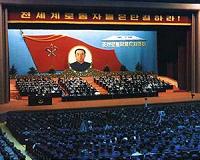
North Korea's former military chief of staff who was reported executed earlier this year is apparently alive and well after being named Tuesday in a number of senior ruling party posts.
Intelligence reports in South Korea had suggested Ri Yong-Gil, former chief of the Korean People's Army (KPA) General Staff, was executed in February on accusations of corruption and forming a political faction.
Although the reports were never confirmed by Pyongyang, North Korea named a new chief of staff, Ri Myong-Su, in the same month.
The change came at a time of highly elevated tensions on the divided Korean peninsula following the North's nuclear test in January and long-range rocket launch.
But on Tuesday, Ri Yong-Gil's name appeared on a list of the newly-elected members of the Workers' Party of Korea (WPK) Central Committee, as an alternate member of the politburo and a member of the party's central military commission.
Reports — some confirmed, some not — of purges, executions and disappearances have been common since Kim Jong-Un took power following the death of his father Kim Jong-Il in December 2011.
A large number of senior officials, especially military cadres, were removed or demoted as the young leader sought to solidify his control over the powerful army.
In the most high-profile case, Kim had his influential uncle, Jang Song-Thaek, executed in December 2013 for charges including treason and corruption.
China's Xi congratulates N. Korea's Kim
Seoul (AFP) May 10, 2016 –
Chinese President Xi Jinping sent a message to North Korea's Kim Jong-Un, congratulating him on his election as ruling party chairman at a congress at which Beijing — Pyongyang's closest ally — was notably absent.
In his message, Xi described ties with North Korea as a "precious asset" that was personally "cultivated by the leaders of the elder generation" the North's official KCNA news agency said Tuesday.
North Korea wrapped up its first ruling party congress in 36 years on Monday, appointing Kim party chairman and formally endorsing his legacy "byungjin" doctrine of parallel economic and nuclear development.
The fact that there was no Chinese representation at the once-in-a-generation gathering was viewed as a sign of fraying ties between the two traditional allies.
A large Chinese delegation had attended the last Workers' Party congress in 1980, headed by Li Xiannian, later China's official head of state.
Beijing has been a key diplomatic protector of North Korea, providing an economic lifeline that has allowed it to ride out waves of international sanctions.
But the relationship between the two nations, once said to be as close as lips and teeth, has become increasingly strained as China's patience with the North's refusal to rein in its nuclear weapons ambitions has worn increasingly thin.
China approved the latest raft of UN sanctions — the toughest to date — that were imposed after the North's January nuclear test, and there are signs that it is implementing the measures.
But China is wary of pushing the North too far, fearing a regime collapse that could create a refugee crisis on its border and swing the regional balance of power towards the United States.
"The Chinese party and government attach great importance to the Sino-DPRK relations," Xi said in his message. "We will make efforts together with the DPRK side to bring happiness to the two countries and their peoples."
DPRK is the official abbreviation for North Korea.
