
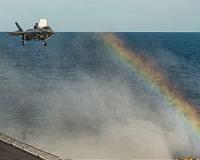
The short takeoff and vertical landing variant of the F-35 Lightning II fighter has successfully been launched from a ski jump at a U.S. Naval Air Station.
The test at NAS Patuxent River in Maryland was to evaluate its compatibility with British and Italian aircraft carriers, which are shorter than U.S. Navy carriers and which use a ramp for take offs as an alternative to the use of catapults, said the spokesman for a F-35 Joint Program Office.
The ski-jump ramp launches aircraft upward and forward, allowing aircraft to take off with more weight and less end-speed than required for an unassisted horizontal launch aboard U.S. aircraft carriers.
"This test was a success for the joint ski jump team," said Peter Wilson, the BAE Systems F-35 test pilot who flew the F-35B. "The aircraft performed well and I can't wait until we're conducting F-35 ski jumps from the deck of the (UK's) Queen Elizabeth carrier."
The F-35B automatically positions the control surfaces and nozzles for takeoff.
"The control laws on the F-35B are designed to make the task of taking off and landing at the ship much easier than for previous STOVL aircraft," said Gordon Stewart, flying qualities engineer representing the UK Ministry of Defense. "For ski jump launches, the aircraft recognizes when it is on the ramp and responds by positioning the control surfaces and nozzles automatically for takeoff and climb.
"This was our first chance to demonstrate these new control laws using a land-based ski jump. We'll be using these results — along with those from future testing — to help us prepare for the first
