
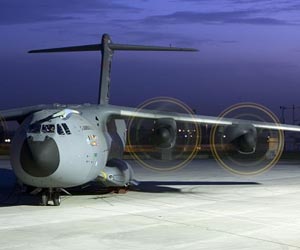
Last-minute talks between European governments and EADS to remove an impasse over financing for the Airbus A400M military freighter ended without result.
The seven European partner governments at Wednesday's talks in Berlin said they were ready to commit an extra $2.8 billion in funding for the delayed and costly plane program — less than a third of the money Airbus wants.
The plane maker and its parent European Aeronautic Defense & Space have asked for around $9 billion on top of the $28 billion in fixed costs for the delivery of 180 planes.
That means the rowing parties are still billions of dollars apart, leaving a conclusion of the talks by the much-heralded Jan. 31 deadline virtually impossible.
German Defense Minister Karl-Theodor zu Guttenberg called the EADS demand "without foundation" but added Berlin would be willing to continue negotiating well into next month. The next meeting is scheduled for Feb. 2 in Berlin.
Abandoning the A400M would mean Airbus would have to pay back some $8 billion in funding to the governments. The company is already pumping some $100 million a month into the program because it has not agreed with the partner governments over its extension.
Yet EADS also says it will lose more money if it continues the program with inadequate additional funding from governments.
Partner nations Germany, Britain, France, Spain, Belgium, Luxembourg and Turkey are eager to save the plane project, which is three years behind schedule and at least $15 billion over budget because of technical problems and mismanagement.
The Financial Times Germany reports that EADS in the past days has made several compromise offers that were apparently denied by the governments.
There is indeed room for maneuvering: EADS could grant governments a share of export sales or shift costs into the future by delivering the planes in two installments, the newspaper said.
The partner countries desperately need a new freighter plane: Britain is eager to modernize its current fleet of Hercules and Boeing C-17 carriers, worn by the mission in Afghanistan; and France and Germany want new transport planes to replace their four-decade-old C-160 Transall machines, which are slow and inflexible.
However, the A400M, which took off for its maiden flight in December 2009, has had engine problems, and Germany has doubts that the plane can be delivered in a reasonable time period.
Share This Article With Planet Earth
