
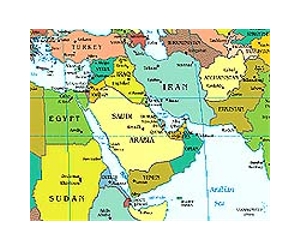
The UN's five permanent Security Council members said Wednesday they were committed to working towards a nuclear weapon-free zone in the Middle East.
"We are committed to a full implementation of the 1995 NPT resolution on the Middle East and we support all ongoing efforts to this end," said the statement to the current Non-Proliferation Treaty review at UN headquarters here.
The zone is mentioned in a resolution from the 1995 review conference of the NPT, and the so-called P5 of Britain, China, France, Russia and the United States stated their endorsement of it.
They called "for the consideration of the establishment of new zones where appropriate and in conformity with the wishes of regional states."
"We are ready to consider all relevant proposals in the course of the review conference in order to come to an agreed decision aimed at taking concrete steps in this direction," the statement said.
But the permanent Council members' statement did not give a mandate for setting up the zone.
The 1995 NPT resolution only calls for "practical steps" towards a zone, leaving open how and when it would actually come into existence.
Egypt is leading non-aligned nations in a push to convene next year a conference to discuss turning the Middle East into a zone free of nuclear weapons.
The need has "doubled" for such a zone as Britain, Russia and the United States have done nothing to carry out their 1995 pledge to set it up, Egyptian Foreign Minister Ahmed Abul-Gheit said in a speech read here in his absence by Egypt's UN Ambassador Maged Abdel Aziz.
The non-aligned states also want Israel, which is believed to have some 200 atomic bombs but does not confirm this, officially declare its arsenal and then join the NPT in order to disarm.
Israel says it will only do this after there is a peace agreement in the Middle East. This position is supported by the United States.
The permanent Council members called for all states to join the NPT, and to disarm if they have nuclear weapons.
"We attach great importance to achieving the universality of the NPT," the statement said.
"We urge those states that are not parties to the treaty to accede as non-nuclear-weapon states and pending the accession to the NPT, to adhere to its terms."
The five major Council nations, which are considering new sanctions against Iran, called on the Islamic Republic to comply with current sanctions ordering it to stop enriching uranium, which can be used to make bombs.
The five said they supported stronger verification work by the UN watchdog International Atomic Energy Agency and said the Additional Protocol which allows for tougher inspections "should become the universally recognized verification norm."
The five re-stated their support for the other pillars of the NPT besides verification, namely the right of states to peaceful nuclear energy and the need for nuclear states to move towards disarmament.
There are different types of nuclear weapon-free zones in the world, including for Antarctica, in Latin America and the Caribbean and in southeast Asia.
Share This Article With Planet Earth
