
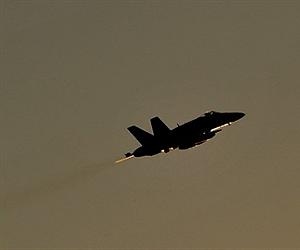
Enforcing a no-fly zone over Libya required four sorties by NATO aircraft in the past 24 hours, the Pentagon said Tuesday.
As of 1000 GMT, NATO carried out four flights to police the no-fly zone against the Libyan regime, along with four other sorties in support of the mission, according to information released by the Pentagon.
The figures followed comments from US and allied commanders that the regime's air defenses have been knocked out in earlier coalition raids, with Moamer Kadhafi's aircraft effectively shut down under a no-fly zone now firmly in place.
The four no-fly zone sorties were flown by Canada and Spain, using F-18 fighter jets, said a US defense official, who spoke on condition of anonymity.
NATO is due on Thursday to take over from the US military the command of the coalition air campaign, launched under a UN resolution to protect civilians.
As part of "Operation Odyssey Dawn," the US military also launched 22 Tomahawk cruise missiles in the past 24 hours, bringing to 214 the total number of missile strikes since the operation began on March 19, the Pentagon said.
The Tomahawks targeted "storage facilities" for the Libyan regime's Scud missiles, the defense official said.
The international coalition carried out a total of 200 sorties in the past 24 hours, with about 60 percent of the missions flown by the American military.
During the same period, the international coalition carried out 115 strike sorties, in which combat aircraft sought out targets in Moamer Kadhafi's armed forces.
Since the air operation began on March 19, the coalition has carried out 1,802 sorties.
President Barack Obama's administration has said it will soon play more of a supporting role in the air campaign.
The number of "strike" missions by US aircraft has declined slightly in recent days.
In the past 24 hours, the United States conducted 52 sorties, about 45 percent of all the strike flights, compared to 63 percent flown by other countries.
earlier related report
No NATO liaison on ground in Libya: alliance chief
Washington (AFP) March 29, 2011 –
NATO has no representative on the ground in Libya to work with rebel forces fighting Moamer Kadhafi's regime, the alliance's top commander told lawmakers on Tuesday.
Admiral James Stavridis also said he had no orders to supply the rebels with weapons and that the alliance was working to get a clearer picture of the opposition, amid intelligence reports that showed "flickers" of a possible Al-Qaeda presence.
When asked if the alliance had a liaison engaged with opposition forces, NATO's supreme allied commander told a Senate hearing: "There is not a NATO representative on the ground in Libya at this time to my knowledge."
US officials have repeatedly said Washington has had no military contacts with the rebels, who have advanced against Kadhafi's troops in recent days with the help of NATO-led air strikes.
However, it remained unclear if the United States or its allies had intelligence agents in the country working covertly with the rebels.
Amid calls from some lawmakers and commentators to supply weapons to the opposition, Stavridis said there were no immediate plans to arm the rebels.
"I have not made or received such a recommendation (to arm the rebels)," the admiral told the Senate Armed Services Committee. "Of course we are in the very early days at this point."
The United States has not ruled out arming the rebel fighters, Washington's UN ambassador Susan Rice said Tuesday.
But Britain's Prime Minister David Cameron has said an international arms embargo precludes supplying weaponry to the opposition.
Stavridis also said intelligence reporting on Libya's rebel forces has shown possible signs of an Al-Qaeda or Hezbollah presence, but opposition leaders appear "responsible."
"We have seen flickers in the intelligence of potential Al-Qaeda, Hezbollah. We've seen different things.
"At this point, I don't have detail sufficient to say that there's a significant Al-Qaeda presence or any other terrorist presence in and among" (rebel forces), he said.
As NATO prepared to take over command of all military operations in Libya, Stavridis said there were no plans for deploying ground troops, which President Barack Obama has ruled out.
But he acknowledged that a possible post-Kadhafi international peacekeeping force could come up for discussion at some point, citing past experience in Kosovo and Bosnia where NATO deployed "stabilization" contingents.
"I wouldn't say NATO's considering it yet, but I think that when you look at the history of NATO, having gone through this as many on this committee have with Bosnia and Kosovo, it's quite clear that the possibility of a stabilization regime exists," he said.
"And so I have not heard any discussion about it yet, but I think that history is in everybody's mind as we look at the events in Libya."
Share This Article With Planet Earth
