
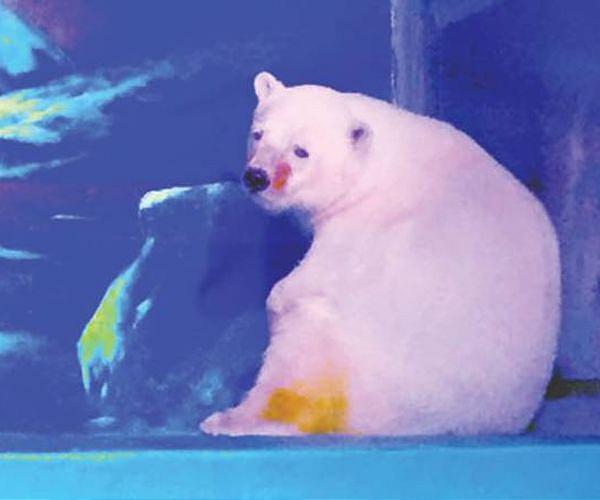
A Chinese hotel built around a central polar bear enclosure for the non-stop viewing pleasure of its guests opened Friday to immediate condemnation from conservationists.
At "Harbin Polar Land" in northeastern China, the hotel bedrooms' windows face onto the bears' pen, with visitors told the animals are their "neighbours 24 hours a day".
A video shows the bears — a threatened species — photographed by crowds of guests under harsh warm lights, in a space consisting of fake rocks and icicles, and a white painted floor.
Animal rights organisations reacted with outrage, urging customers to stay away from establishments profiting "from animals' misery".
"Polar bears belong in the Arctic, not in zoos or glass boxes in aquariums – and certainly not in hotels," said PETA Asia's Vice President Jason Baker.
In the wild, polar bears usually roam territories that can span thousands of miles, Baker added.
Harbin is famous for its ice-carving festival, and the hotel resembles a giant igloo, with its roof topped by artificial ice. But some Chinese social media users expressed unease at the theme being taken to this extreme.
"A panoramic prison for polar bears… haven't we learned anything about animal cruelty?" one commentator said.
"Gaps in China's wildlife protection law allows businesses to exploit animals without any concern for their welfare," a spokesman for China Animal Protection Network, who declined to be named, told AFP.
Chinese authorities recently changed the law to ban the consumption of wildlife for food, after speculation over the origins of the coronavirus nudged investigators towards a Wuhan market selling animals.
But the use of parts of endangered species in traditional medicine remains rampant, and Chinese circuses and zoos are often criticised for poor standards in animal housing and care.
Raccoons to snakes: Shanghai animal cafes expand to exotics
Shanghai (AFP) March 12, 2021 –
A baby raccoon to stroke while you sip your skinny latte? Or a snake to coil around you after your cappuccino?
Forget dog or cat cafes, Shanghai's animal cafe scene has expanded to include a wider — and more exotic — kingdom.
The fad in dining alongside all manner of species — from raccoons to pigs and reptiles — comes despite pandemic-fuelled concerns about the dangers of deadly viruses jumping from wild animals to humans.
There are dozens of animal cafes in China's biggest city, with visitors helping to drive the craze by posing for photos with the creatures and sharing them on social media.
Tucked away in central Shanghai, Raccoon Cafe is home to eight of the mammals. The biggest of them, weighing about 10 kilos (22 pounds), jumps up and down by a window, seemingly agitated by customers.
"I think it's really cute," said Qin Siyu, a 27-year-old professional volleyball player who found out about the cafe from a friend's pictures.
Customers pay from 98 yuan ($15) for entry but it is debatable how much of the venue actually functions as a cafe.
The raccoons' behaviour is too unpredictable for people to have hot drinks around them and the menu is limited.
The cafe's owner, Cheng Chen, admits she had no first-hand experience of raccoons before taking over the establishment at the end of last year.
They can be aggressive, she says, and has the scars on her wrists to prove it.
The 36-year-old understands why some people may question whether it is fair for the raccoons to be kept in a cafe, eating dog food.
Cheng, who seems to have a genuine affection for the raccoons, is an animal lover and has several dogs and cats at home.
She hopes the government will make it more difficult to own and breed such animals, to prevent them from falling into the hands of people who are less concerned about their welfare.
"Generally there's no special regulation. In fact, especially in China, the regulation for pets may be relatively weak," she said.
– 'Huge suffering' –
In another Shanghai cafe, snakes, iguanas and geckos wait to delight customers.
Owner Wang Liqun has 30 snakes, among them Corn snakes and Kingsnakes — neither is venomous but they can bite. Wang is yet to have such an incident with a customer.
A visitor who gave only her surname Tang said the cafe helps people to get over their fears.
"After coming here they will feel that it's not what they thought and may find reptiles actually quite lovely," said the 27-year-old.
But Evan Sun, a scientist with World Animal Protection, said that he was "deeply concerned" about such cafes.
"Wild animals are having a miserable life in these cafes, enduring huge suffering and pressure," said Sun, the charity's wildlife campaign manager for China.
"The close interactions with wild animals not only fuel suffering and cruelty, but also creates a hotbed of diseases that could exacerbate the likelihood of zoonotic diseases' emergence and spread.
"Most customers visit animal cafes are animal lovers, but they do not know that their consumption choices have such a negative impact to both wild animals and humans."
