
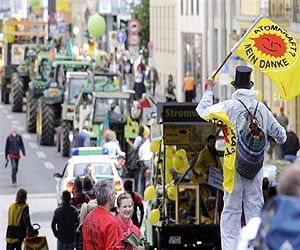
Germany's decision to end nuclear power by 2022 gives it 10 years to find alternative sources of energy, but only six months to avoid a winter blackout, say critics of the government move.
Chancellor Angela Merkel, in a major policy U-turn, said on Monday that all 17 of the country's nuclear reactors would be closed at the latest in 2022, a measure taken for safety reasons in the wake of the disaster at Japan' Fukushima plant.
But Germany must already do without eight of these reactors as Merkel, in March, ordered that the seven oldest plants be withdrawn from the network, pending her policy review.
In addition, an eighth plant, Kruemmel, in northern Germany, has been offline for years because of repeated technical problems.
As a result, electricity producers, power-lines providers, and the federal agency responsible for the electricity grid have all warned of possible outages this winter.
"The situation will be under control during the summer months, but the autumn and winter will be marked by flux in voltage," the federal agency said in a statement.
"We produce enough electricity. The problem is rather one of grid stability," Claudia Kemfert, an energy expert at the German Institute for Economic Research (DIW), told AFP.
Closing eight old nuclear plants which together produce 8.5 gigawatts (billion watts) has a minimal impact in a country which has an overall production capacity of 929 gigawatts for a top consumption of 80 gigawatts.
But the fact that five of the power plants now at a standstill are located in the south and west, the most heavily-populated and industrialised part of the country, will cause distribution problems, experts say.
To function properly, electricity generation must keep tension stable throughout the grid.
But this balance could be upset in winter when demand in southern Germany is at a peak and northern wind turbines try to keep pace, overloading power cables and causing blackouts.
Germany's four largest electricity producers have already called on the government to grant a reprieve to one or two of the eight mothballed nuclear plants so they can help stabilise the grid.
Sources close to the Free Democrats (FDP), Merkel's junior partners in the ruling coalition, told AFP that at least one reactor might be kept on "standby" rather than be closed.
But the EON, RWE, EnBW, and Vattenfall producers are sceptical.
"You don't just switch a nuclear power plant on and off," one industry representative said.
The government plans to shut down six more reactors by the end of 2021 and the three most modern ones by the end of 2022.
But it has so far failed to explain how it will make up for the lost nuclear power.
Merkel's spokesman Steffen Seibert said the government would ensure that Germany still produced enough cheap energy to satisfy both private customers and industry, while ensuring that new means of production did not impact plans to reduce greenhouse gas emissions or increase energy imports.
The government is banking on renewable energies, especially wind power. But Germany will also have to build new conventional power plants, relying either on coal, of which it has plenty, or natural gas, if only to avoid sudden outages due to lack of wind or too little solar power.
"Gas-fired plants are better than coal-powered plants because they pollute less and, because they are flexible, they mix well with renewable energy," Kemfert said.
But the need for more gas will also mean increased imports, especially from Russia.
earlier related report
Nuclear power: top producers worldwide
Paris (AFP) May 30, 2011 –
Germany's decision to give up nuclear energy production by 2022 would reduce the total number of commercial reactors worldwide by less than four percent.
With a total of 17 units out of 440 worldwide, the country has 3.8% of the world's operable nuclear power reactors, according to data from the World Nuclear Association.
The following figures show the 10 biggest nuclear energy-producing nations worldwide, listed in terms of total output as of 2009.
The table also shows the total number of operable reactors for each state, as of April this year, and the percentage of total demand that is provided by nuclear energy.
Eight of Germany's reactors are currently not supplying energy to the power grid, and the Berlin authorities say the present share of nuclear power in the country's total energy output is 22%.
As of 2009, nuclear energy accounted for 13.8% of total world production of electrical energy, according to the World Nuclear Association.
The catastrophic earthquake and tsunami that hit Japan on March 11 this year knocked several of that country's nuclear reactors out of action.
COUNTRY NO. REACTORS OUTPUT (1) ENERGY SHARE (2)
United States 104 798.7 TWh 20.2 %
France 58 391.7 75.2
Japon 51 263.1 28.9
Russia 32 152.8 17.8
Germany 17 127.7 26.1
South Korea 21 141.1 34.8
Canada 18 85.3 14.8
Ukraine 15 77.9 48.6
China 13 65.7 1.9
Britain 19 62.9 17.9
(1) Expressed in terawatthours, or billions of kilowatt-hours, in 2009.
(2) Nuclear's percentage of national electricity production, also in 2009.
