
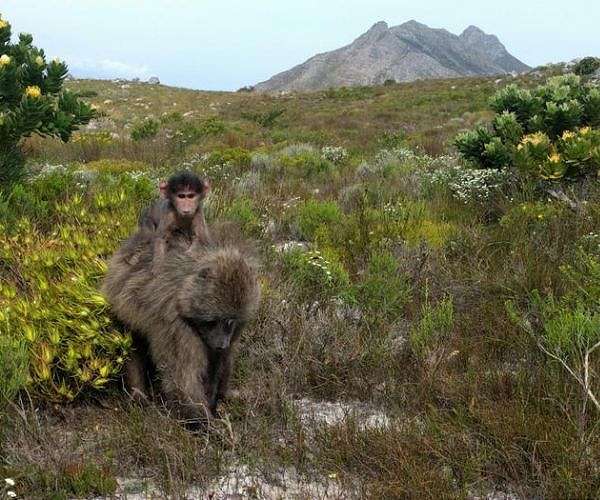
Researchers from the German Primate Center have revealed that Guinea baboons regulate the transfer of meat through established social dynamics closely paralleling human hunter-gatherer communities. Drawing from nearly a decade of behavioral records and 109 observed meat-eating events, the team demonstrated that meat shares tracked the closeness of social ties. Transfers were more peaceful and likely between kin or tight social allies, while unrelated members experienced theft more frequently.
Guinea baboons (Papio papio) live in a multi-level social structure: units consist of a male and several females with young, a cluster of units forms a party, and two to three parties unite as a gang. Most passive and conflict-free sharing occurred within the smallest unit level. Transfers between different levels became scarcer and tenser, reflecting diminishing intimacy across social echelons.
Data from the DPZ Simenti field station in Senegal detailed 320 meat transfer cases, frequently from males to females within the same unit or between males in a party. "We were able to show that Guinea baboons pass meat along their social bonds," said William J. O'Hearn, the study's lead. "This form of tolerant sharing is reminiscent of the behavior of human hunter-gatherer groups, where meat is first distributed within the family and only then reaches more distant acquaintances or neighbors."
Statistical models revealed that an individual's chances of obtaining meat increased with the strength of its social relationship to the animal holding the meat. Notably, Guinea baboons did not proactively offer food but instead passively enabled transfers. The socially closest animal typically took over the remains left by the initial eater-highlighting that social tolerance is instrumental for these resource exchanges.
Julia Fischer, head of the DPZ Cognitive Ethology Laboratory, highlighted the broader significance: "This suggests that certain social patterns may have developed independently in humans and non-human primates, but in comparable ways." The findings underscore that multi-level social societies-regardless of species-can shape resource flows through similar mechanisms.
Research Report:Meat transfer patterns reflect the multi-level social system of Guinea baboons
