
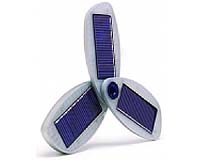
GWS Technologies has announced that it is developing a portable solar charger, the GWS Solstice, as part of its microgeneration product line. Microgeneration refers to the production of low-carbon electricity by individuals, small businesses and communities to meet their own energy requirements.
The GWS Solstice is designed to be a handheld solar charger that can recharge personal electronic devices from cameras and mobile phones to MP3 players and games consoles. The solar panels fan out for charging, but fold up to wallet-size and can be carried in a pocket or a purse.
The Solstice will feature adaptors for charging various devices, an internal lithium battery, and rugged construction.
"As solar panels have become thinner, lighter and more efficient, portable solar power has become a practical alternative energy source for consumer electronics," said GWS Technologies Director of Technology Steve Stubblefield.
"We are currently working with several manufacturers, both foreign and domestic, to source the most advanced solar technologies for integration in the GWS Solstice."
There is an emerging market for small consumer microgeneration products, as people realize that every amp of electrical energy they generate themselves reduces their individual carbon footprint and also reduces their dependence on the "grid," or commercially generated electricity.
However, the mass production of solar chargers has been limited globally by a recent shortage in silicon wafers, the main material used to make solar panels.
GWS Technologies is currently evaluating alternative types of photovoltaic solar modules that are readily available and which have definite advantages over more rigid, heavier and more fragile traditional solar panels.
Globally, higher demand for solar energy, triggered by concerns about global warming, are projected to drive an increase in the annual revenues of the global solar equipment industry from $20 Billion in 2006 to $90 Billion in 2010, with profit margins expected to accelerate even faster, pushing margins up to nearly 60 percent.
