
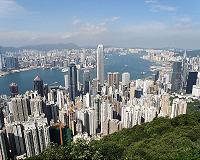
Hong Kong might be heading for recession after months of violent protests but that hasn't stopped one businessman from forking out almost $1 million for a parking spot.
The mind-boggling sum paid by Johnny Cheung Shun-yee highlights the gaping inequality that has helped fuel nearly five months of demonstrations in the financial hub, where one in five people live below the poverty line.
The HK$7.6 million ($970,000) price tag is more than 30 times the average annual wage in Hong Kong and about the same as a one-bed apartment in London's plush Chelsea area.
It is situated in The Centre, the city's fifth-highest skyscraper, which hit the headlines in October 2017 when it became the world's most expensive office building after Hong Kong's richest man sold it for more than $5 billion.
The purchase comes even though there are growing concerns about the impact of the pro-democracy demonstrations on the city's real estate market with property firms' share prices plunging in recent months, as they are forced to offer discounts on new projects and cut office rents.
The economy has been tipped to grow just 0-1.0 percent this year, the worst rate since 2009 during the global financial crisis.
"A lot of those owners in The Center are in finance or in other high-growth businesses," Stanley Poon, a managing director at Centaline Commercial, said. "To these tycoons, it's not a significant purchase if you compare it to the value of the office floors they own."
Hong Kong's white-hot property market has become a political issue as costs continue to soar, forcing some small businesses to close owing to sky-high rents while many residents cannot afford to buy or lease decent homes.
Commercial and residential property prices have been fuelled by an influx of money from wealthy mainland Chinese investors and developers.
While the long-running protests in the city are fired mostly by anger at a now-dead extradition bill and hatred towards the government and police, they are also fanned by anger at the huge disparity between rich and poor.
China growth smooth as silk for Hermes
Paris (AFP) Oct 24, 2019 –
French luxury goods maker Hermes said Thursday that its sales accelerated in the third quarter thanks in particular to China despite the unrest in Hong Kong.
For the three months to the end of September the maker of leather bags and silk scarves saw sales rise 18.2 percent to 1.7 billion euros ($1.9 billion).
Excluding the effects of exchange rates and other factors such as the number of stores, growth still came in at 15 percent.
The company's financial director, Eric du Halgouet, described the quarter as an exceptional performance with double-digit sales growth in all regions of the world.
In Asia, which alone accounts for half of sales, the growth was just over 20 percent.
"There was no disruption to the trend in continental China," said du Halgouet.
In particular he noted Hermes was attracting younger clients thanks to embracing e-commerce.
Hermes' site is "attracting new clients and is enjoying faster growth than our shops," said du Halgouet, adding it also brought the brand added visibility.
He acknowledged sales had faltered in Hong Kong, where pro-democracy campaigners have staged demonstrations for months that have occasionally turned violent and forced Hermes to close its stores.
However du Halgouet said sales for the year to date remain up.
Sales in Paris shops have also rebounded following "Yellow Vest" street protests, he added.
The firm's leather goods, which account for nearly half of sales, saw sales rise by 11.5 percent and Hermes has plans to launch additional workshops.
Shares in Hermes rose 2.1 percent in morning trading while Paris' blue-chip CAC 40 index was up 0.5 percent.
