
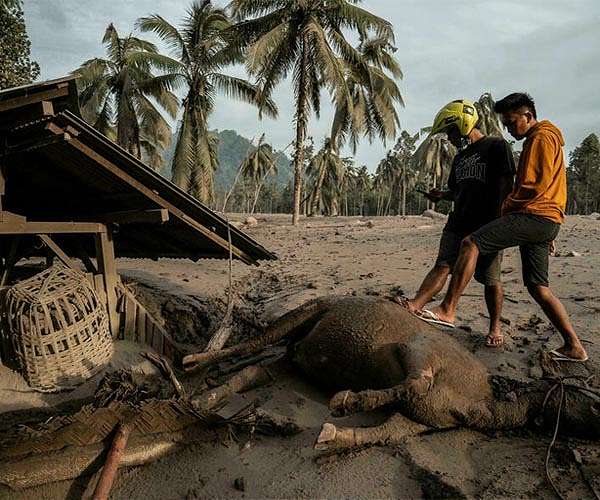
Three days after Indonesia's Mount Semeru erupted and rained burning mud and ash on it, the village closest to the volcano was shrouded in grey — many of its homes destroyed, streets full of debris and trees felled like matchsticks.
Fewer than 20 kilometres (12 miles) from the crater of Java island's tallest mountain, Curah Kobokan was largely deserted Tuesday as emergency crews combed through husks of buildings with tools and rescue dogs, hoping to find survivors — or bodies.
As the hot ash spewed by Semeru on Saturday descended on the village, thatch roofs were ripped off weaker structures. The volcanic debris even tore through corrugated metal.
Only a handful of homes appeared to have been spared the worst.
"My family house here in Curah Kobokan is destroyed," said sand miner Marzuki Suganda, who lives and works in a nearby village.
"I'm traumatised, I asked my relatives if they were brave enough to go back to Curah Kobokan and they all said no, they'd rather sleep under a tree."
Inside the living room of one home, volcanic dust stained everything — including the coffee table and couch next to it.
The family photos on the walls were hidden behind layers of ash.
The shattered remains of the roof filled all the rooms of the house. Through one destroyed door, some clothes and a backpack hung covered with dark grey dust.
Outside in the muddy and ash-covered streets, a search and rescue operation was under way, with crews going house to house while taking care to avoid uneven, dangerous surfaces and unstable structures.
A small pickup truck was seen loaded with salvaged household items.
– 'We have no solution' –
The village was home to an estimated 50 families before the eruption, many of whom worked at the sand mines that pepper Semeru's slopes.
The volcanic deposits in the area are rich for sand extraction, but they expose the mines and the settlements around them to the constant danger of an eruption.
"It's a dilemma… working in a sand mine guarantees stable income," said miner Siyadi, who goes by one name like many Indonesians.
"We have needs. I know the risk is high but what else can we do?"
Indonesian President Joko Widodo said during a trip to the affected area that around 2,000 homes may need to be relocated after the eruption, which has killed at least 34 people and displaced thousands.
But for many who depend on the sand mines in the shadow of Semeru, there are few other options.
"If the government shut down sand mines, would they provide for us? Would there be another job?" asked Siyadi.
"We have no choice, no solution."
The latest eruption of Semeru was the turning point for Marzuki Suganda, however.
"If I were told to live here again, I wouldn't dare," the 30-year-old said.
"I'd think 1,000 times about going back to work as a sand miner.
"This place will become a ghost town. No ne wants to come back here… It is very dangerous living here."
Indonesia volcano eruption death toll rises to 34
Curah Kobokan, Indonesia (AFP) Dec 7, 2021 –
The death toll from the eruption of Indonesia's Mount Semeru volcano rose to 34 on Tuesday, the national disaster agency said, as aid was rushed to the affected region.
The mountain on the island of Java thundered to life on Saturday, ejecting volcanic ash high into the sky and raining hot mud on villages as thousands of panicked people fled their homes.
The disaster swallowed entire homes and vehicles, blanketing villages like Curah Kobokan in grey ash and leaving residents terrified of returning home.
"I'm traumatised, I asked my relatives if they were brave enough to go back to Curah Kobokan and they all said no, they'd rather sleep under a tree," said Marzuki Suganda, a 30-year-old who works at a sand mine in the area.
"When the eruption happened, I really thought I was going to die here."
Rescuers have been battling dangerous conditions since the deadly weekend eruption, searching for survivors and bodies in the volcanic debris, wrecked buildings and destroyed vehicles.
Search crews deployed dogs on Tuesday to aid the operation.
"The latest update from the ground… (is) 34 people died," the disaster agency spokesman Abdul Muhari told AFP.
At a later press briefing, the military commander of Lumajang district Irwan Subekti said that "22 people have been declared missing".
"The number of evacuees is 4,250," he said, adding that 26 were seriously injured.
– Dangerous rescue operation –
Semeru has remained active since Saturday, keeping emergency workers and area residents on edge.
There were three small eruptions on Tuesday, each spewing ash around a kilometre (3,300 ft) into the sky, authorities said.
The task for rescuers was made more difficult by the instability of the volcanic debris.
"What we are afraid of is the ground being cold outside but still hot inside," said police officer Imam Mukson Rido. "If it's hot inside, we must get away."
Officials have advised locals not to travel within five kilometres (3.1 miles) of Semeru's crater, as the nearby air is highly polluted and could affect vulnerable groups.
Indonesian President Joko Widodo said during a trip to the area Tuesday that the government will look into moving homes away because of the threat posed by the volcano.
"I hope after things calm down we can start both fixing infrastructures and think about the possibility of relocation from areas we believe to be dangerous," he told Indonesia's Metro TV.
"Earlier I got a report (that) there are around 2,000 houses that must be relocated."
Indonesia sits on the Pacific Ring of Fire, where the meeting of continental plates causes high volcanic and seismic activity, and the country has nearly 130 active volcanoes.
