
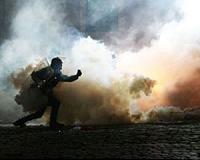
The row of tense Iraqi police readied their tear gas canisters to disperse swelling crowds.
Facing the officers, demonstrators donned their equipment too — plastic buckets, soda cans and gardening gloves.
The rivals faced off on a main bridge of the Iraqi capital, with protesters advancing from Tahrir Square and itching to reach government offices across the river in the Green Zone.
Black-clad riot police held them back, unleashing wave after wave of tear gas, but not using live rounds.
After a week of protests early this month that a national rights watchdog says ended with at least 157 dead, demonstrators came ready with their own improvised defences.
Some had gathered plastic trash bins from the streets and chased down the canisters, capping the devices with bin lids to diminish the debilitating effect of the gas.
Others put the buckets on their heads in an attempt to ward off cans that could hit them in this sensitive area.
A few donned thick gardening gloves, to pick up the searing hot containers and toss them straight back at the police, while others just kicked them away.
The best-equipped protected themselves with navy blue face masks normally used by painters.
Their less fortunate comrades fashioned makeshift devices, shearing the top off a can of Pepsi and taping it to a paper mask covering their mouth and nose.
"Now if I get hit with the gas, my eyes water a little from the gas but I won't suffocate," one protester told AFP.
Even the rainy weather was in their favour, with occasional showers and cool breezes clearing clouds of lingering gas.
The chemical agent in tear gas canisters causes severe irritation of the eyes, nose and throat, prompting coughing fits and breathing difficulties.
Soda, lemon juice and milk have been used for years by protesters around the world to lessen the symptoms.
A few Iraqis on Friday loaded up their cars with crates of soda, driving as close to the rallies as they could before security forces stopped them.
They popped open their trunks and waved over other protesters, who hoisted the crates and continued on foot to where the crowds were facing off against riot police.
"Take these to our protesting brothers," they said.
Some two dozen protesters died on Friday across Iraq, according to the Iraqi Human Rights Commission, including several hit by tear gas canisters.
Over 1,700 more were wounded across the country, most of them affected by the gas itself.
The renewed protests come after the week of rallies earlier this month, when most of the 157 who died were killed by live rounds in Baghdad, according to the rights watchdog.
This time around, security forces in the capital appeared to have orders to rely on tear gas over gun shots.
"We know how to handle this tear gas now," one protester said early on Friday.
"But we'll be afraid if they start using live rounds," he had cautioned.
Iraq: protests, bloody clashes resume
Baghdad (AFP) Oct 25, 2019 –
Violent anti-government demonstrations that left more than 150 people dead in Iraq early October resumed this week, with thousands again on the streets to protest corruption and unemployment.
Here is a recap:
– Spontaneous gatherings –
On October 1, more than 1,000 people take to the streets in Baghdad and cities in southern Iraq to protest corruption, unemployment and poor public services.
Heeding calls on social media, demonstrators gather in the capital's iconic Tahrir (Liberation) Square in what seems to be a spontaneous movement.
Riot police disperse crowds with water cannons, tear gas and rubber bullets. They fire live ammunition when protesters regroup.
The first deaths are reported.
– Unrest spreads –
On October 2, protests multiply across southern Iraq and riot police fire live rounds at demonstrations in the capital and the southern cities of Najaf and Nasiriyah.
Influential firebrand Shiite cleric Moqtada Sadr, whose bloc is the biggest in parliament, announces support for "peaceful protests and a general strike".
Authorities impose a curfew in Baghdad and other cities.
– Battles in Baghdad –
On October 3, major clashes break out as thousands defy the curfew to march in Baghdad and across the south.
In the capital, riot police and soldiers again fire live rounds. Crowds block streets and burn tyres in front of government offices in several cities.
The internet is cut for most of the country.
Prime Minister Adel Abdel Mahdi defends his year-old government on television, asking for more time to implement reforms.
– Sadr calls for polls –
On October 4, clashes intensify in Baghdad as large numbers of security forces try to enforce the curfew and block access to Tahrir Square.
Several protesters are struck by bullets, some in the head and the stomach. Security forces blame "unidentified snipers".
Iraq's revered Shiite spiritual leader, Grand Ayatollah Ali Sistani, endorses the demonstrations.
In the evening, Sadr calls on the government to resign and for early elections under UN supervision.
– Reforms announced –
On October 5, the curfew in the capital is lifted and protesters gather outside the oil ministry in Baghdad, again facing live fire.
On October 6, the cabinet announces reforms, including land distribution, boosted social welfare and the ousting of corrupt officials.
On October 7, the military admits "excessive force" had been used.
The powerful Hashed al-Shaabi, a network of majority-Shiite paramilitary units, announces it is ready to back the government to prevent "a coup".
Calm returns and Baghdad lifts security restrictions on October 8.
– Death toll: 157 –
On October 20, Sadr gives his supporters the green light to resume protests. Calls are made on social media for rallies on October 25, the anniversary of Abdel Mahdi's government taking office.
On October 22, an official inquiry announces that the death toll from the week of protests totalled 157, most killed in Baghdad.
The government announces the dismissal of a host of security force commanders.
– Second wave –
Anti-government rallies resume on October 24, with hundreds descending into the streets of Baghdad earlier than anticipated, and rallies in the southern cities of Diwaniyah and Nasiriyah.
On October 25 protesters are out in the thousands, massing near the capital's high-security Green Zone.
Security forces use tear gas to push them back and two people are killed.
Protesters are shot dead in the southern city of Amarah as they try to storm the Asaib Ahl al-Haq headquarters.
There are more deaths in nearby Nasiriyah, where protesters set fire to the government's provincial headquarters
In the evening the Iraqi Human Rights Commission gives a toll of at least 21 protesters killed in Baghdad and the south of the country.
