
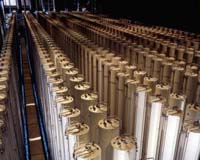
Iran has enriched and stored more than 100 kilogrammes (220 pounds) of enriched uranium, its interior minister said in remarks published on Friday on the eve of top-level talks over its controversial nuclear programme. "We have currently 3,000 operational centrifuges and delivered more than 100 kilogrammes of enriched uranium to warehouses," said Mostafa Pour-Mohammadi, quoted by the ISNA news agency.
He added that Iran had also stocked more than "150 tonnes of uranium gas."
Iran has come under intense US-led pressure and UN sanctions over its nuclear programme which it insists is for peaceful purposes and to which it has a right as a signatory to the Non-Proliferation Treaty.
The West suspects Tehran's work is aimed a producing nuclear weapons.
Later on Friday, Iran's top nuclear negotiator, Ali Larijani, is due in Vienna to meet Mohamed ElBaradei, director of the UN nuclear watchdog, the International Atomic Energy Agency.
That meeting will be followed on Saturday by talks in Portugal between Larijani and EU foreign policy chief Javier Solana
Iran has been slapped with two sets of UN Security Council sanctions and it is likely to face a third for its refusal to suspend sensitive enrichment work, the process which makes nuclear fuel but can also, in highly-enriched form, provide the fissile core of an atom bomb.
Israel air force training for distance missions: report
Jerusalem (AFP) Jun 22 – Israel's air force is training for long distance missions, after agreeing a timetable with the United States for sanctions against Iran's nuclear programme to work, a report said on Friday. Israel's tabloid-style Maariv daily, which said the military censor had authorised its report, said the training included long-range strikes as well as in-flight refuelling.
The newspaper gave no further details of the flights but said Israel and the United States would hold joint assessments at the end of the year of the effectiveness of economic sanctions against Iran.
A new package of tougher sanctions was drawn up in Tuesday's talks between Israeli Prime Minister Ehud Olmert and President George W. Bush, including pressure on European governments to cancel guarantees worth 22 billion dollars a year to firms trading with Iran, the paper said.
The draft package also includes sanctions against banks working with Iran and measures to stop the OPEC cartel's number two producer of crude from maintaining its oil infrastructure, the paper added.
After the White House talks, Bush said he hoped to resolve the Iran nuclear dispute diplomatically but insisted that all options, including military action, remained on the table.
The UN Security Council has already adopted two packages of economic sanctions against Iran after it defied ultimatums to suspend uranium enrichment.
Iran insists it has the right to master the nuclear fuel cycle as a signatory of the Non-Proliferation Treaty and says its nuclear programme is for civilian purposes only.
But Israel, the Middle East's sole if undeclared nuclear power, suspects — together with the West — that the Islamic republic's real aim is to develop a nuclear arsenal that would dramatically tip the balance of power in the region.
Iran's uranium enrichment facility is near the central city of Natanz, the best part of 1,600 kilometres (1,000 miles) from the nearest Israeli air base.
In between lie Jordan and Iraq, the latter still under the security control of Israel's key ally, the United States, but with a Shiite-led government that is friendly to Iran.
On January 7, Israel denied a report in Britain's Sunday Times newspaper that it had drawn up plans to destroy Iran's enrichment facility with a tactical nuclear strike.
Quoting several Israeli military sources, the London paper said Israel had drawn up plans to destroy the centrifuges at Natanz using low-yield "bunker-busting" bombs.
It quoted the sources as saying that two of the Jewish state's air force squadrons were training to use the weapons for a single strike.
Source: Agence France-Presse
