
The Iraqi cabinet has approved a bill calling for all foreign soldiers except for American forces to pull out of the country by the end of July, a top MP said on Tuesday.
"The cabinet has approved draft legislation on the withdrawal of non-US forces in the coalition," said Hummam Hammudi, chairman of parliament's foreign affairs committee.
"It sets a timetable for a withdrawal of between five and seven months from January 1."
The bill, which has to be passed by parliament, would mainly affect the roughly 4,100 British troops deployed at Basra air base in the south of the country.
London newspapers have reported that Britain intends to begin its withdrawal in March with most troops out by June, although defence officials insist the precise timetable will depend on conditions on the ground at the time.
"We plan — subject to the conditions on the ground and the advice of military commanders — to reduce our force levels in Iraq as we complete our key tasks in Basra in the early months of next year," a British defence ministry spokesman said last week.
From a peak of 46,000 British soldiers in 2003, when Britain joined the invasion, just 4,100 now remain in Iraq.
After a meeting with Hammudi, British Ambassador Christopher Prentice told AFP the bill would pave the way to a new relationship between London and Baghdad.
"This law … provides the legal base for us to complete our mission here, and to complete our support for the Iraqi armed forces and to continue essentially our training role in supporting the Iraqi forces," he said.
"This law and the subsequent arrangements to be agreed with the government will together provide the bases for moving into a new relationship with the new Iraq," said Prentice.
"We look forward to a vote in the next weeks in parliament on that law, and we hope that it will be accepted."
Up to 400 British soldiers are likely to remain to help train Iraqi forces, while equipment such as helicopters and drones will be transferred to Afghanistan.
Since the 2003 US-led invasion, 177 British troops have died in Iraq.
US soldiers, who make up 95 percent of the coalition, are to have withdrawn from Iraq by the end of 2011, under a security pact signed last month after Iraqi parliamentary approval.
Their combat troops are due to have pulled out of Iraqi cities by June.
US president-elect Barack Obama, who takes office on January 20, included in his election campaign a 16-month deadline for an accelerated withdrawal from Iraq.
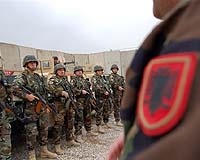
The US military on Tuesday announced the departure of the multinational coalition's Albanian and Moldovan contingents, in the last such pullout before the end of 2008.
Apart from the Americans and British, Australia, Denmark, El Salvador, Estonia, Lithuania and Romania also still have troops in Iraq.
Foreign troop numbers in Iraq
Here is a list of different countries' contributions to the US-led multinational force in Iraq, as well as planned reductions and withdrawals.
Total current force levels are nearly 152,000.
UNITED STATES: About 146,000 troops.
BRITAIN: Around 4,100. British newspapers reported last week that Britain will start pulling troops from Iraq in March and most will leave by June.
AUSTRALIA: 980 personnel.
ROMANIA: Planned to keep its 397 troops in place until 2011.
EL SALVADOR: 280.
MACEDONIA: 80.
LITHUANIA: Around 40, with end of their mandate set for December 2010.
ESTONIA: 34. Their government announced on November 20 that their mission was being prolonged to December 2009.
CZECH REPUBLIC: Around 20 soldiers.
Other countries that are in the process of withdrawing or have recently withdrawn their troops:
ALBANIA: Its 120 forces are to withdraw on December 18.
ARMENIA: Its 46 soldiers left on October 7.
BOSNIA: Its roughly 40 infantry troops returned home on December 16.
BULGARIA: Announced that it would pull its 155 soldiers out by the end of 2008.
DENMARK: Around 50 soldiers are still in the country.
GEORGIA: Most of the 2,000 soldiers in Iraq since August 2003 were rushed back after August 10 to face up to Russian troops during the conflict involving the separatist regions of South Ossetia and Abkhazia.
JAPAN: Japan has ended its air mission flying goods and personnel into Iraq.
KAZAKHSTAN: 29 mine clearance specialists withdrew in October 2008.
MOLDOVA: Moldova's 20 mine clearance experts experts are to withdraw on December 18.
POLAND: The last of its remaining 900 soldiers withdrew at the end of October.
SOUTH KOREA: Its last 650 men are due to leave by December 20.
TONGA: Withdrew its 55 soldiers at the beginning of December.
Since 2003, several other countries have taken part in the multinational force but have since withdrawn. They are Azerbaijan, Japan, Nicaragua, Spain, the Dominican Republic, Honduras, Philippines, Thailand, New Zealand, Portugal, Mongolia, Netherlands, Hungary, Singapore, Norway, Ukraine, Italy, Slovakia, Latvia and Armenia.
