
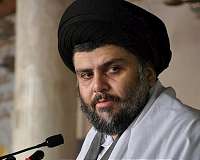
Iraqi Prime Minister Haider al-Abadi and nationalist cleric Moqtada Sadr on Saturday said they had formed an alliance in a bid to create a new government after May polls.
Sadr's joint list with communists won 54 seats in the legislative elections to become the biggest bloc in Iraq's 329-seat parliament, while Abadi's bloc came in third, scooping just 42 seats.
On Saturday Abadi travelled to the Shiite shrine city of Najaf to meet Sadr.
After three hours of talks they issued a joint statement announcing they had set up a coalition.
The statement said their alliance "transcends sectarianism and ethnic" issues "in order to speed up the formation of the new government and agree on the principles which serve the aspirations of our people".
A source close to Sadr's Marching Towards Reform alliance said the thorniest issue is who will fill the post of prime minister in the new government.
Abadi would like to keep the job but is meeting resistance from rivals who beat his bloc in the election.
Saturday's joint statement did not mention an alliance Sadr formed earlier this month with two other lists, ahead of a manual recount ordered by Iraq's supreme court amid allegations of fraud.
Last week the firebrand Sadr, a former militia leader, reached a coalition agreement with the pro-Iranian former fighters under Hadi al-Ameri, whose list came second in the election with 47 seats.
Before that, Sadr formed an alliance with Shiite Ammar al-Hakim's Al-Hikma list, which won 19 seats, and the secular outgoing vice-president Iyad Allawi, whose list was comprised largely of Sunnis and secured 21 seats.
Judges limit Iraq vote recount in new twist
Baghdad (AFP) June 24, 2018 –
Judges appointed by Iraq's top court said Sunday they would limit a manual recount of votes in a May parliamentary poll to districts where results were contested, in a new twist to the country's electoral saga.
The recount, demanded by the supreme court, "concerns only polling centres where candidates filed complaints to the High Electoral Commission, or in cases of official reports of suspected fraud in Iraq or abroad," the judges' spokesman, Laith Hamza, said in a statement.
The court ordered a recount on June 21, in line with a decision adopted by parliament in response to allegations of irregularities.
Top judge Medhat al-Mahmud said at the time that all 11 million ballots cast, including those of voters living abroad, displaced persons and security forces, would have to be recounted.
The result was contested — mainly by the political old guard — after allegations of fraud in Iraq's first election since the defeat last December of the Islamic State group.
The supreme court, whose rulings are final, also ratified parliament's decision to dismiss Iraq's nine-member electoral commission and have them replaced by judges.
The timing of the recount will be set in the presence of representatives of the United Nations, political entities and of the candidates affected, the judges said.
A recount of all votes would have taken weeks, going beyond the June 30 expiry date of the mandate of the incumbent parliament.
Last month's ballot was won by populist Shiite cleric Moqtada Sadr's joint list with communists, as long-time political figures were pushed out by voters seeking change in a country mired in conflict and corruption.
The vote, in which electronic voting machines were used in Iraq for the first time, saw a record number of abstentions.
A recount is unlikely to produce a major change in the number of seats won by rival lists, according to experts on Iraqi politics, but rather modify the rankings of candidates within the same lists.
