In May 1864, on the banks of Tasmania’s Plenty River, brown trout ova carried from England in a chilled box aboard the ship Norfolk began to hatch, the first successful brown trout hatching in Australia. Australian Geographic dates the moment to 4 May, the culmination of years of trial shipments organized by Sir James Arndell Youl, who had worked out how to keep fertilized eggs dormant in ice and moss across the equator. One hundred and sixty-odd years downstream, a small brown-and-gold native fish that shared those waters is down to roughly 6,000 individuals, and in 2023 conservationists carried 180 of them into three trout-free havens in the state’s north-east. ABC News reported the translocation and the numbers on 27 July 2026.
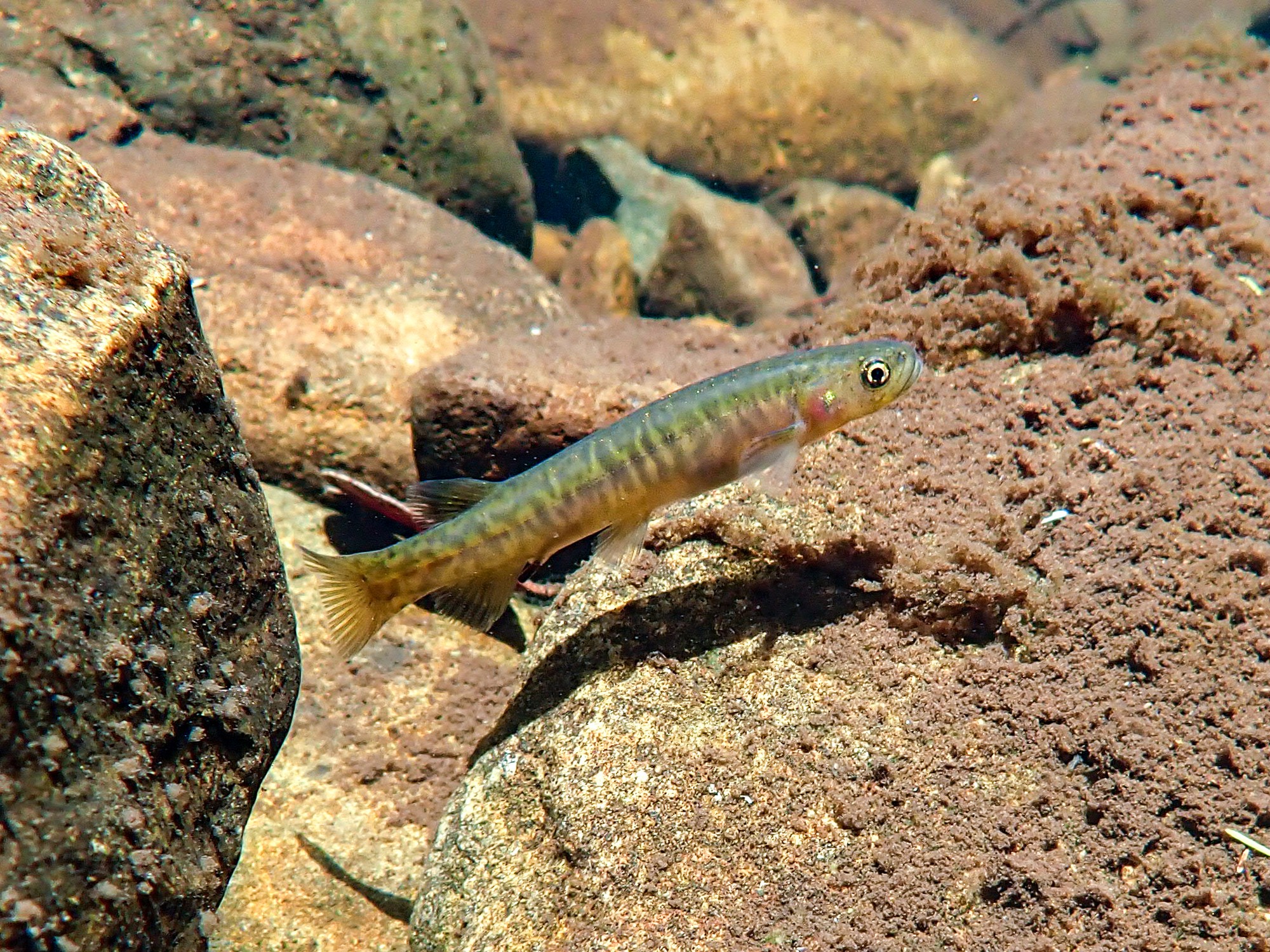
The fish is the swan galaxias, Galaxias fontanus, found nowhere on Earth but Tasmania. It is scaleless, rarely longer than a finger, and spends its life in cool, clear headwater streams, holding position over gravel and feeding on whatever drifts past. It is also, by the language of its own conservation listing, at imminent risk of extinction within the next 20 years.
The box of ice that changed Tasmanian rivers
Youl’s achievement was a logistical one. Ova packed in ice and moss, insulated in the hold, could survive months at sea if the temperature stayed low enough to hold development in suspension. Earlier attempts failed. The 1864 shipment did not, and the eggs that hatched at the Plenty seeded a hatchery culture that spread brown trout across Tasmanian waterways and then across the mainland’s cool-water rivers and lakes.
What followed was not an accident so much as a program. Trout were stocked deliberately, repeatedly, and with civic enthusiasm, into rivers that had never held a large predatory fish of that kind. Tasmania’s native freshwater fauna evolved in the absence of anything quite like a brown trout: a fast, adaptable ambush predator that eats fish smaller than itself and competes for the same drift of insects. Redfin perch, another introduction, arrived through a similar appetite for familiar European sport and has spread through lowland waters and impoundments.
Today the Inland Fisheries Service continues to stock trout, and recreational fishing is a substantial part of the state’s outdoor economy and identity. That is the balancing act conservation managers work inside: the same species that anchors a fishery is, in particular headwater streams, the reason a native fish has nowhere left to go.
About 6,000 fish, and the gauntlet they swim
The swan galaxias occupies a handful of streams in the Swan and Macquarie river catchments. ABC News puts the total at about 6,000 individuals left, a figure that says as much about the size of the remaining habitat as about the fish themselves. These are not big populations spread thin; they are small populations pinned into short reaches of creek, often above a waterfall or a culvert that predatory fish cannot climb.
Trout and redfin perch are the principal predatory pressures, but the decline is not a single-cause story. Habitat fragmentation matters: barriers that keep predators out also keep galaxias in, so a population wiped out by a bad season has no natural way to be recolonized from downstream. Climate compounds it. Drought shrinks headwater pools to disconnected puddles and warms them past comfort; flood scours gravel beds and can flush small fish downstream into water where trout are waiting. Land use, riparian condition and water extraction all shape how severe each of those events becomes.
The result is a species that can be doing reasonably well in one creek and gone from the next within a season, with no mechanism for recovery. NRM South, which has run project work on the species, has focused on exactly this problem: securing existing sites, and finding or creating new ones where the fish can live without predators.
One hundred and eighty fish, carried upstream
The 2023 translocation moved 180 swan galaxias into three trout-free havens in north-east Tasmania. That is the whole intervention, stated plainly: a few hundred fish, hand-selected, transported, released into streams chosen because trout and redfin cannot reach them, usually because of a natural barrier or a stretch of water that predators have never colonized.
Conservation translocation of small freshwater fish is unglamorous work. Sites must be surveyed for predators, for flow reliability, for temperature, for enough insect food and enough gravel for spawning. Source populations have to be robust enough to give up fish without being weakened. The fish travel in aerated containers, are acclimatized to the receiving water, and are released in numbers small enough to fit in a bucket and large enough, in theory, to found a breeding population.
ABC News reports that the relocated fish have bred substantially and that new viable populations have been recorded at the haven sites. That is the qualitative result, and it is the one that matters most in the short term: the fish are not simply surviving where they were put, they are producing young there.
It changes the arithmetic only at the margins. Against a total of about 6,000 individuals, 180 fish in three streams is not a recovery. What it is, is insurance. Each haven is a population that a single drought, a single flood, or a single predator incursion in the original creeks cannot erase, and each one adds a place from which the species could, in principle, be expanded again. Brown trout are not leaving Tasmania; they have been hatching in its rivers since the Plenty in 1864 and they underpin a fishery the state values. The swan galaxias survives instead in the gaps those fish have not reached, and conservation here means finding those gaps, guarding them, and carrying 180 fish at a time into the ones that are still empty.