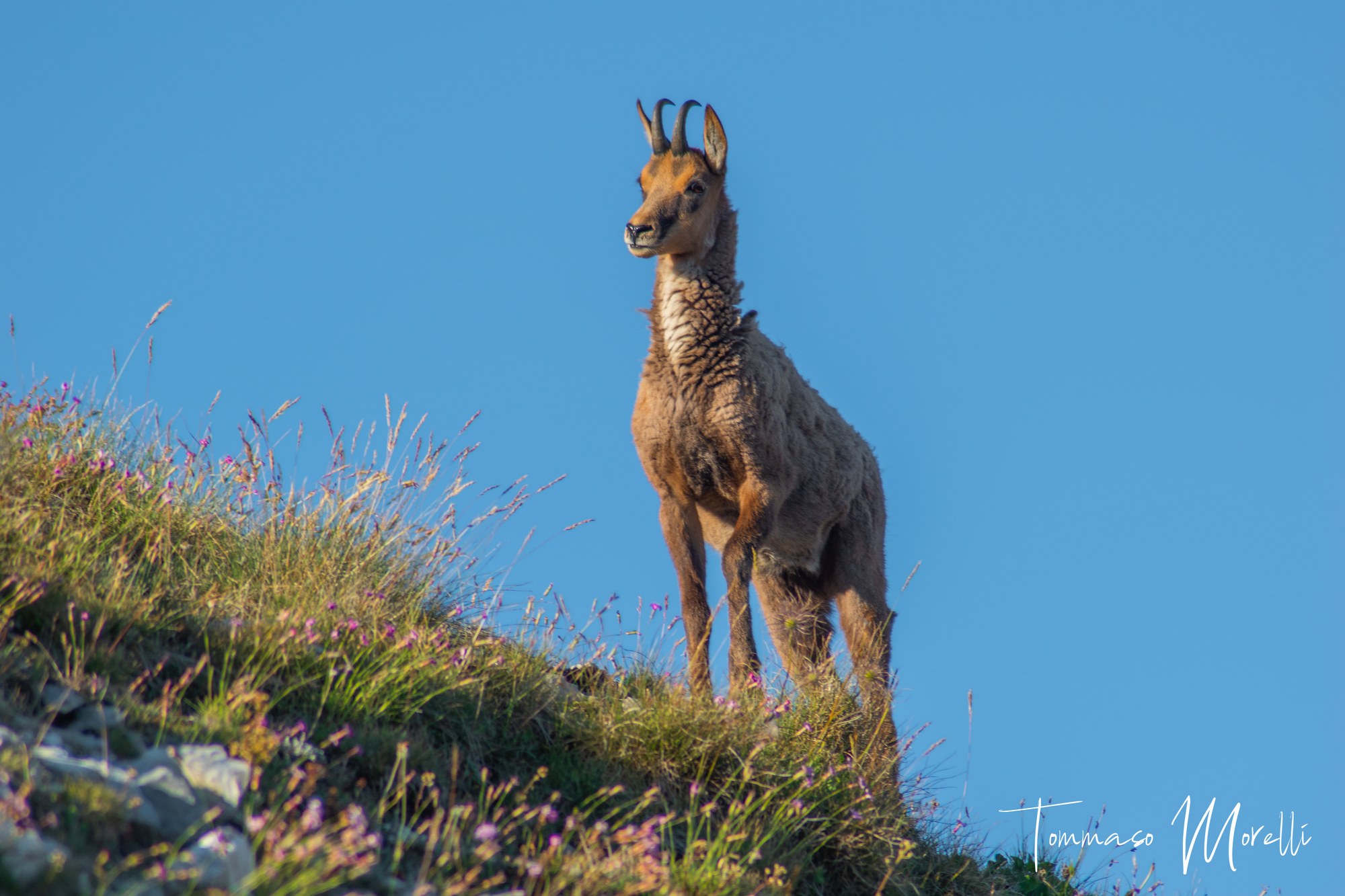
Forty Apennine chamois walked out of their transport crates and onto the limestone of Majella National Park between 1991 and 2006: 22 females and 18 males, released in batches across fifteen years into a massif in Italy’s Central Apennines where the subspecies had been absent. About two decades on, the herd descended from those founders exceeds 1,300 animals and is still on a growing trend, according to a long-term evaluation by Antonucci and colleagues published in the Journal of Nature Conservation (doi:10.1016/j.jnc.2025.126950, record at UniChieti). The paper describes that release as the first reintroduction of the Apennine chamois ever attempted, and it now has enough monitoring behind it to be read as an outcome rather than a hope.
That is the arithmetic worth sitting with. Twenty-two breeding females, released over a decade and a half, standing behind a four-figure population on a single mountain group.
Forty founders, released in installments
Rupicapra pyrenaica ornata is a mountain ungulate of the Central Apennines, smaller and more sharply marked than its Alpine cousin, with the pale throat patch and the dark facial stripes that make an adult unmistakable through a spotting scope at a kilometer. For much of the twentieth century its entire world was reduced to a single surviving nucleus, which made the species one of the most range-restricted large mammals in Europe and made every additional occupied massif a genuine change in its status rather than a rounding adjustment.
Majella was the first place anyone tried to add. The releases ran from 1991 to 2006, and the composition matters as much as the total: 22 females and 18 males, a founder group small enough that each animal represented a meaningful share of the genetic and demographic starting capital. Reintroductions of large herbivores often stall in exactly this phase. Founders disperse, fail to find each other in the breeding season, lose kids to predators or weather in the first winters, and the curve flattens near zero before it ever bends upward.
What the Antonucci evaluation documents is the other trajectory. Considering a time span of roughly 25 years from the first release, the population passed 1,300 individuals and continued to show a growing trend. The founders did not merely persist. They colonized.
The nursery range tripled, and the groups got big
The most telling number in the paper is not the population total but a pair of areas. The distribution range used by females with kids, the summer nursery habitat that determines whether a population can actually reproduce across a landscape rather than in one favored basin, measured 7.9 square kilometers in 2000. By 2022 it covered 23.9 square kilometers.
That is a threefold expansion of the ground where chamois mothers are willing to raise young, and it is a harder-won metric than raw counts. Female chamois with kids are conservative about terrain. They want steep escape ground within a short run, reliable alpine grassland, and the social company of other nursery groups. A nursery range that keeps widening means successive generations of females have judged new slopes acceptable and stayed there through the vulnerable months.
The social structure that has emerged looks like a population with room to organize itself. Mixed groups of more than 200 animals are frequently observed, the kind of aggregation that a tiny founder herd simply cannot produce. The largest male-only group recorded numbered 71. The overall sex ratio reached 1.1 males to females, close to parity, which is what you expect once a population moves past the lopsided demographics of its first cohorts and into steady turnover.
For anyone who has watched a reintroduced ungulate herd for years, the shift from counting individuals to counting groups of two hundred is the moment the project stops being an experiment.
What a four-figure count settles, and what it leaves open
Growth curves do not run forever, and the authors do not pretend otherwise. The paper reports that the birth rate declined from roughly 0.70 to 0.80 in the early 2010s to roughly 0.35 to 0.55 in 2021 and 2022, and the authors describe this as a potential density-dependence effect: the signature of a population approaching the limits of its best habitat, where forage competition and social crowding begin to shave reproductive output before total numbers ever fall.
That interpretation belongs to the authors, and it is offered as a possibility rather than an alarm. A halving of the birth rate in a population still growing past 1,300 is not the same thing as a population in trouble. It is, more plausibly, what maturity looks like: the early explosive phase of a colonization ending, the curve beginning to bend toward whatever ceiling the Majella massif actually imposes.
So the number settles some questions and leaves others standing. It settles whether 40 founders can seed a self-sustaining Apennine chamois population outside its last refuge. It settles whether nursery habitat can be colonized progressively rather than occupied all at once. It does not settle how many chamois Majella can ultimately hold, whether the birth-rate figures of 2021 and 2022 mark a durable plateau or a short dip, or how the herd will fare through the drought years and heavy winters that a mountain population eventually meets.
What stands is the count. Twenty-two females and 18 males, released across fifteen years into one Italian national park, now exceed 1,300 descendants spread over a nursery range three times the size it was in 2000, still growing, still expanding into slopes nobody released them onto.