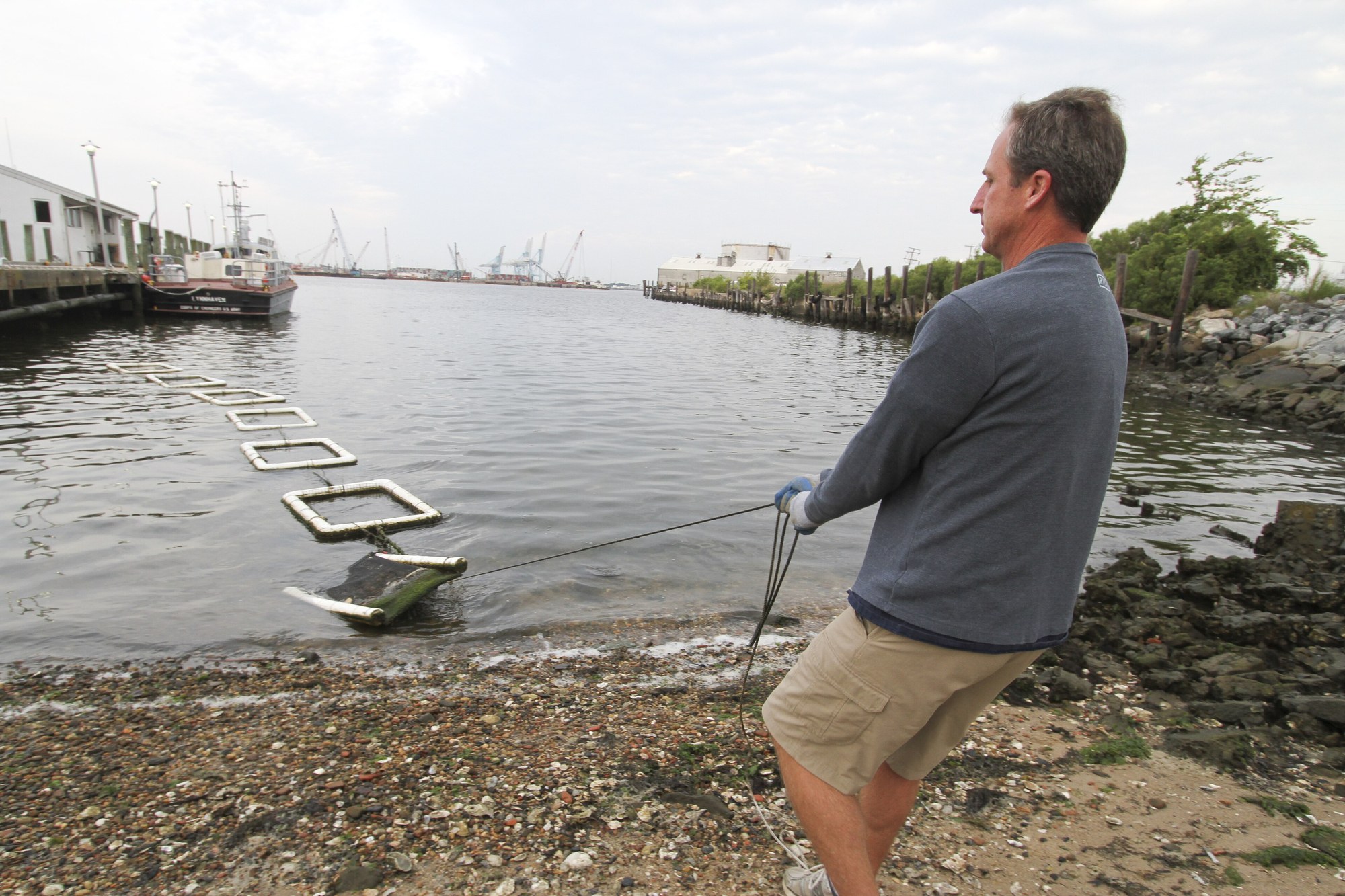
Ten tributaries by 2025. That was the number written into the 2014 Chesapeake Bay Watershed Agreement, which committed its signatories to restore native oyster habitat and populations in 10 Bay tributaries by 2025 and to ensure those reefs stayed protected afterward. By late 2025, according to the partnership’s completion analysis, crews working in Maryland and Virginia had planted roughly 7.3 billion oysters across 1,905 acres of actively restored reef habitat, and had finished work in eleven tributaries rather than ten.
The count is the story here. Not a metaphor about resilience, not a promise about the Bay’s future, but a tally of acres surveyed, substrate placed, and spat-on-shell dropped over the side of a boat across roughly a decade of seasons.
A goal written as a number, then turned into a blueprint
The 2014 Agreement’s oyster outcome was unusual among watershed commitments in that it named a unit of measure and a deadline. Ten tributaries. By 2025. That framing pushed the work out of the realm of general habitat improvement and into something closer to construction scheduling, with each river treated as a discrete project that could be declared finished or unfinished against defined criteria.
Maryland and Virginia each took five tributaries, and an interagency workgroup drew up the approach that would govern all of them: pick candidate rivers, survey what reef was already there and in what condition, set acreage targets per tributary, then build and seed toward those targets. The surveys mattered as much as the planting, because they established the baseline that determined how many acres actually needed intervention and how many were already functioning.
Partners worked the list river by river. In Maryland: Harris Creek, the Little Choptank, the Tred Avon, the upper St. Mary’s, and the Manokin. In Virginia: the Lafayette, the Piankatank, the Lynnhaven, the lower York, and the Great Wicomico. Virginia then added an eleventh, the Eastern Branch of the Elizabeth River, beyond the original commitment. The partnership has described the combined effort as the world’s largest oyster reef restoration project, a framing that belongs to the partners rather than to any independent tally, and one better read as scale-setting color than as a settled scientific ranking.
The acreage arithmetic, and what counts as restored
The completion analysis separates two categories of reef, and the distinction is worth holding onto.
The first is acreage that partners actively restored, meaning reef where crews placed substrate, seeded oysters, or both: 1,905 acres in total, split 1,310 acres in Maryland and 595 acres in Virginia. The Maryland share is larger in part because several of its tributaries required more extensive substrate placement to rebuild reef structure that had been reduced over generations of harvest and sedimentation.
The second category is reef that pre-restoration surveys found already healthy and meeting the partnership’s criteria without further work: 488 acres. Those acres were not built. They were identified, documented, and then folded into the tributary-scale accounting because a restored river is meant to contain functioning reef habitat, regardless of whether a given patch needed a boat to put it there.
Added together, the two categories produce 2,393 acres of healthy reef across the eleven tributaries, or about 3.75 square miles. That is a small figure set against the surface area of the Chesapeake, and the partnership does not present it otherwise. It is a large figure set against what any single restoration project had previously assembled in one estuary.
7.3 billion oysters, $121.16 million, and the questions that stay open
The planting number is the one that tends to travel: about 7.3 billion oysters seeded across the restored acreage. Most of that total arrived as hatchery-produced spat set on recycled shell, then broadcast over prepared reef bottom, where survival depends on salinity, disease pressure, sedimentation, and whether the substrate beneath holds together long enough for the next generation to settle on it.
The completion analysis also puts a price on the construction side: approximately $121.16 million Bay-wide through the end of 2025. That figure covers reef construction and seeding only. It does not include the surveys that established baselines, nor planning, permitting, or the monitoring that will determine whether these reefs hold. The real public and private investment in the ten-plus-one tributaries is therefore higher than $121.16 million, and the analysis is explicit that its cost accounting is narrow by design.
What completion settles is narrow too. Eleven tributaries met the partnership’s acreage and seeding targets within the window the 2014 Agreement set. That is a scheduling and construction outcome, and it is verifiable. What it does not settle is whether these reefs reproduce, recruit, and persist as self-sustaining habitat over decades, whether protection from harvest holds in each river, and whether the tributary-scale model can be extended to additional rivers under whatever oyster goals succeed the 2014 outcome. Monitoring on the finished reefs continues, and the useful data on reef persistence is the data that has not been collected yet.
There is also the matter of what a finished goal does to momentum. A deadline met can become a stopping point as easily as a foundation, and the Agreement’s language about ensuring protection of restored populations describes an obligation with no end date attached.
For now, the ledger reads as it reads. Roughly 7.3 billion oysters, 1,905 acres actively restored, 2,393 acres of healthy reef across eleven Chesapeake tributaries by late 2025. That is habitat rebuilt against a decade-long partnership target, counted and documented river by river. It is not a declaration that the Bay’s oysters have been restored, and the partnership’s own analysis does not make one.