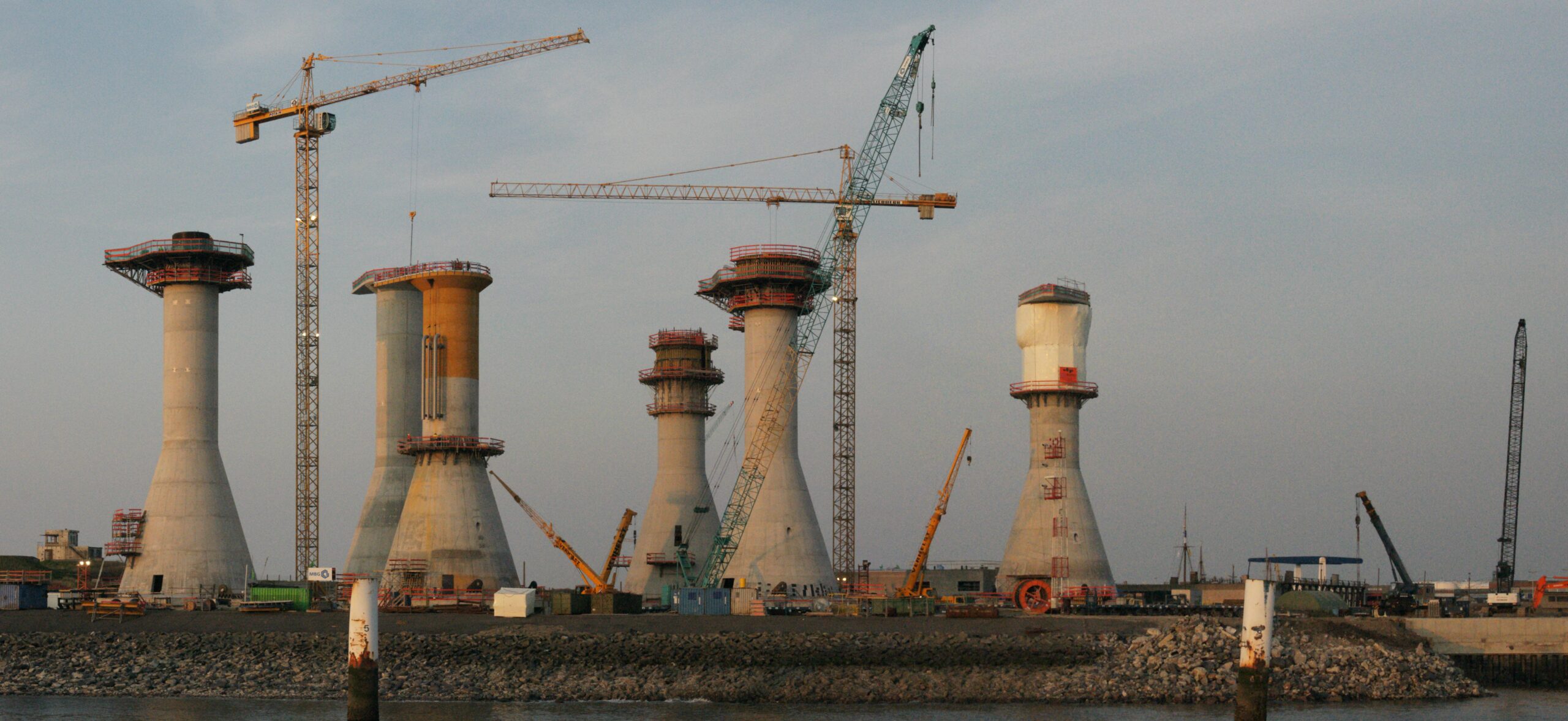
A concrete box 58 meters long and 28 meters wide, weighing about 22,000 tonnes, does not look like electrical infrastructure. Twenty-three of them do. On Easter Monday, April 21, 2025, the first of those caissons left the quayside at Vlissingen in the Netherlands and began a tow of about 53 nautical miles (roughly 98 kilometers) to a patch of North Sea about 45 kilometers off the Belgian coast, where, as Elia Transmission Belgium reported on April 30, 2025, the first two units were ballasted down and submerged at their final positions on the seabed. Those two boxes were the opening move on the perimeter wall of the Princess Elisabeth Energy Island. In the same period, the price tag attached to the project has been anything but settled: VRT NWS reported in October 2024 that an original estimate of €2.2 billion had risen to €3.6 billion and was then being described as likely to reach at least €7 billion.
Twenty-three boxes, one ring
The caissons are the most legible objects in the whole scheme, which is part of why they carry the story. Each is a hollow reinforced concrete cell, about 58 meters by 28 meters in plan, with heights varying between roughly 23 and 32 meters depending on whether the unit carries a storm wall on its seaward face. Full displacement mass per unit lands near 22,000 tonnes. They were cast in a dedicated facility at Vlissingen, floated out, and towed in sequence to the site, with Elia describing an installation cycle of roughly 24 hours per caisson once a unit arrived on location: position, ballast, submerge, check.
Placed end to end, the 23 units form the outer perimeter of an artificial island, a ring rather than a platform. The 2025 campaign ran through the weather window and closed in October 2025. By late January 2026, offshoreWIND.biz reported that the remaining caissons were waiting at the Scaldia terminal in Vlissingen, being readied for a spring installation campaign, and recapped the starting point: installation had begun the previous April when the first two of 23 were submerged. The work is being executed by the TM Edison consortium, a joint venture of Belgian marine contractors DEME and Jan De Nul, for Elia, the Belgian transmission system operator.
In August 2026, Jan De Nul announced that the 23rd and final caisson had been installed and that the foundation works were complete. That is a precise claim and worth keeping precise: the ring is closed, the island is not finished.
What the ring is for
Inside that perimeter, the next phase is fill. Sand is pumped into the enclosed area using a technique dredging crews call rainbowing, the arcing spray from a vessel's bow nozzle that builds new ground out of suspension. Baltic Wind, summarizing the milestone in August 2026, set out the sequence that follows: cable connections to the mainland scheduled for 2027 and 2028, electrical infrastructure in 2029, and final project completion planned for 2031.
The purpose of all that concrete and sand is to give high-voltage equipment a place to stand 45 kilometers from shore. The island is designed as the collection hub for the Princess Elisabeth Zone, Belgium's second offshore wind development area, gathering power from new wind farms and sending it to the Belgian grid. offshoreWIND.biz puts the connected capacity at at least 2.1 GW, and describes the project as the first artificial energy island built to combine high-voltage direct current and high-voltage alternating current infrastructure on a single site. HVAC handles the nearer wind farm connections; HVDC is the technology of choice for long-distance transmission and for potential interconnection with other countries. Those interconnection options have shifted over time. August 2026 coverage mentions a possible link toward the United Kingdom, while VRT's earlier reporting discussed a Denmark connection that had been placed on hold.
There is a smaller layer of detail worth noting without inflating it: the caisson structures have been designed with nature-inclusive features, including surfaces intended to encourage oyster and reef growth. It is a design intent on a hard structure in the North Sea, not a proven ecological outcome, and the monitoring will take years.
The estimate that kept moving
The cost line is the part of this project that has changed fastest, and it needs to be handled as what it is: a series of reported estimates, not a fixed contract price. VRT NWS reported in October 2024 that the island had originally been estimated at €2.2 billion, that the figure had been raised to €3.6 billion before the summer of 2024, and that it was then being reported as likely to be at least €7 billion, with the possibility of more. The drivers cited were the cost of HVDC equipment and high-voltage substations, and a global order book swollen by Europe's climate ambitions pushing manufacturers' prices upward. Elia, per that reporting, confirmed a significant increase. The Belgian energy minister asked the regulator CREG to intervene, reflecting the fact that transmission infrastructure costs eventually reach consumers through network tariffs.
None of that has been resolved into a single published final number, which is why "climbed towards €7 billion" remains the accurate formulation rather than a statement of what the island costs.
What exists, verifiably, is a closed ring of 23 concrete boxes on the seabed 45 kilometers off Belgium, each roughly 22,000 tonnes, towed there one at a time from a Dutch quayside between April 2025 and August 2026. The sand, the cables, the converter equipment and the 2031 completion date are all still ahead, and so is the final accounting.