
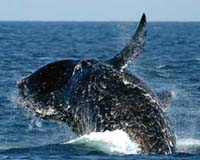
Japan on Wednesday cut short its annual whaling expedition, which was dogged by environmental protests, after a ship was badly damaged by fire, officials said. The six-vessel fleet, which set out for a five-month hunt in mid-November, headed home after killing little more than half its intended catch, the Fisheries Agency said. Fire broke out two weeks ago on the 8,030-tonne mothership, the Nisshin Maru. One crewman was killed and the ship was powerless to move for a week in icy Antarctic waters.
"After discussions this week regarding the condition of the vessel, we have decided to call them home," said Hiroshi Hatanaka, head of the state-run Institute of Cetacean Research.
Japan has used a loophole to get round an international moratorium on commercial whaling but makes no secret that the meat eventually winds up on Japanese dinner plates.
The fleet had planned to hunt up to 850 Antarctic minke whales and 10 fin whales, but left after killing 505 minkes and three fins, a Fisheries Agency official said.
The agency said it hoped to repair the ship for another expedition this year.
"Far from an embarrassment, the situation in the Antarctic was an unfortunate event that no one could have predicted," Hatanaka said in a statement.
The fleet was closely followed by anti-whaling activists. On one occasion, activists of the hardline Sea Shepherd group hurled bottles containing chemicals at the fleet.
Hideki Moronuki, the whaling chief at the Fisheries Agency, said the Coast Guard would probe the cause of the fire.
"The Nisshin Maru was obstructed by the Sea Shepherd on February 9 and the fire occurred on February 15. We think there is a low possibility that it was cause and effect but we cannot be 100 percent sure," Moronuki told AFP.
US-based Sea Shepherd has denied responsibility for the fire but rejoiced in the departure of the Nisshin Maru, describing it as "the Death Star."
"This ship is the single greatest whale-killing machine of all time and the only thing more pleasing to us would be to see its total destruction," it said.
Australia and New Zealand consider the Antarctic Ocean a sanctuary for whales and have angrily protested Japan's whaling, to little avail.
Greenpeace said one of its ships escorted the Japanese out of Antarctic waters Wednesday.
The Esperanza sent a radio message expressing sympathy for the loss of the crew member but added: "This must be the last time your government sends you to the Southern Ocean to hunt whales and threaten the Antarctic environment.
"For the sake of the environment, the whales and your crew, never again!"
Japan, however, has already said it plans to increase its hunt in the next season, including expanding its catch to humpback whales.
Source: Agence France-Presse
