
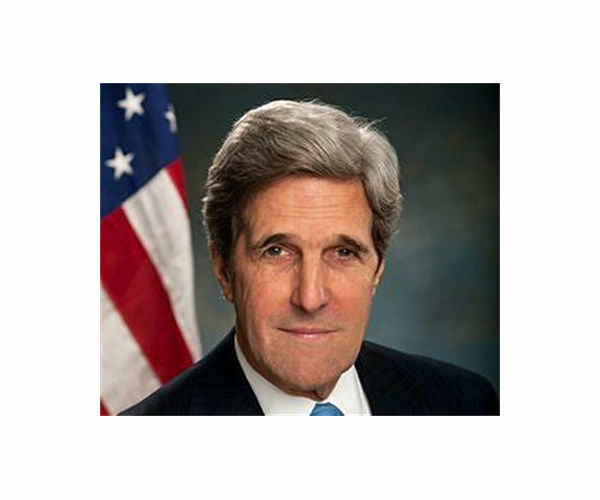
US climate envoy John Kerry warned on Tuesday that Brussels and Washington must revive their joint efforts to fight climate change before the damage becomes irreversible.
In Brussels for his first face-to-face talks with EU officials since the change of government in Washington, Kerry warned: "We face an extraordinary crisis."
As secretary of state under former president Barack Obama, Kerry worked with EU capitals to build the 2015 Paris Agreement on climate, only to see the next US leader Donald Trump pull Washington out of the pact.
Now, under Trump's successor President Joe Biden, Kerry has returned to government as climate envoy, and Britain will host a new UN climate gathering in Glasgow in November to renew the world's efforts.
"So as I come here to renew conversations with our friends in Europe over our cooperation on climate — which was extraordinary in the lead up to Paris — it will have to even be stronger," Kerry warned.
Kerry was welcomed by EU vide-president Frans Timmermans, who is leading Brussels' Green Deal growth plan, and who said the visit proved of the Americans: "They are back. They are back in Paris."
The US envoy was to sit down with European Commission president Ursula von der Leyen and her top team.
"This is the moment," Kerry warned. "Glasgow is the last best opportunity that we have. The best hope that the world will come together and build on Paris."
But he said getting the Paris agreement alone was not enough, warning that even if countries meet their commitments global temperature could rise dangerously.
"And we're not doing all that we set out to do in Paris. So this is the moment for countries, common sense governments people to come together and get the job done. We can do it."
Timmermans welcomed him and promised: "We are going to be working hand in hand to make a success of Glasgow.
"I'm absolutely convinced that the United States and Europe working together, we can move mountains."
UK banks face climate conflicts of interest: study
London (AFP) March 9, 2021 –
British banks face potential conflicts of interest over climate change because almost 80 percent of board members have links with high-polluting sectors, a study showed on Tuesday.
DeSmog, an investigative climate campaign group, revealed the main finding of its research into UK banks' management.
A majority of 50 out of the top 64 directors at the five biggest UK banks — Barclays, HSBC, Lloyds, NatWest and Standard Chartered — have past or present links to major polluters, DeSmog said in a statement.
And one quarter of directors have, or have had, direct links with the carbon-intensive fossil fuel sector, it added.
"The analysis … shows many of the banks' directors have close ties to polluting industries and their financial backers, either as current directors, advisors or previous employees," DeSmog concluded.
"This could affect their ability to be impartial judges of shareholder resolutions trying to push the banks to actually end financing of fossil fuels."
Standard Chartered declined to comment. Barclays, HSBC, Lloyds did not immediately respond to requests for comment.
A NatWest spokesperson stressed it had made operations net carbon zero by the end of 2020 — and planned to make them climate positive by 2025.
HSBC has previously stated that it aims to achieve net-zero carbon emissions across its investments by 2050.
Both Barclays and HSBC meanwhile face shareholder motions to curb or phase out exposure to fossil fuels.
"Banks have a significant role to play in addressing the climate crisis by cleaning up their portfolios, and removing support for environmentally damaging industries," said Rachel Sherrington, DeSmog's lead researcher for the study.
"Public support for scientifically-led action on the climate crisis is high, and the directors of the UK's banks have the chance to put themselves on the right side of history."
The corporate world faces mounting demands to respond to climate change.
Oil giants BP and Royal Dutch Shell have both vowed to achieve net-zero carbon emissions by 2050 — but both faced criticism from green campaigners over a lack of detail.
The British government, which has committed to reaching net zero carbon emissions by 2050, will host the UN climate gathering COP26 in Glasgow in November.
