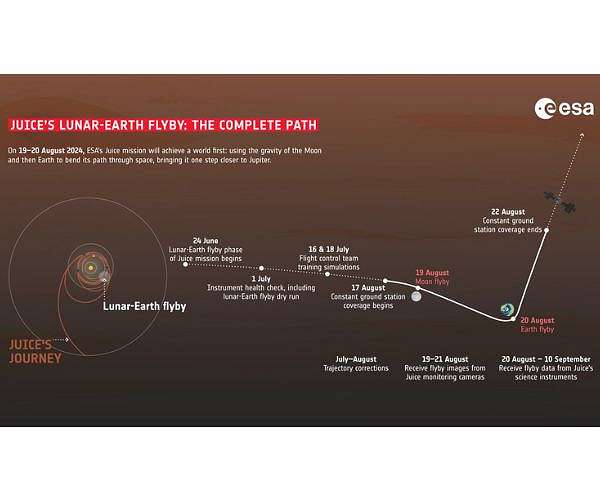
The European Space Agency's (ESA) JUICE mission is set to undergo an important space maneuver called the Lunar-Earth Gravity Assist (LEGA). This complex maneuver will alter the spacecraft's trajectory using the gravitational pull of both the Moon and Earth. For the first time, a space probe's path will be modified by the Moon's gravity, followed shortly by Earth's. During the night of August 19-20 (CEST), JUICE will pass the Moon from its night side at an altitude of 750 kilometers. Within 24 hours, the probe will approach Earth at a speed of 15,000 kilometers per hour, coming as close as 6,800 kilometers, before heading toward the inner Solar System.
Throughout these flybys, several scientific instruments will be activated to test and calibrate their functions, possibly even capturing significant data. Notably, the JANUS camera and the GALA laser altimeter, both heavily supported by the German Aerospace Center (DLR), will be among the instruments utilized.
This maneuver is designed to conserve fuel for JUICE's journey, which will include three additional flybys – one of Venus and two of Earth – culminating in its arrival at Jupiter and its moons in 2031. JUICE is expected to study Jupiter's icy moons – Europa, Ganymede, and Callisto – until 2035.
The LEGA maneuver is a high-stakes operation, controlled by ESA's European Space Operations Centre (ESOC) in Darmstadt, Germany. The spacecraft's precise trajectory will be monitored continuously from August 17-22, 2024. Radio communication with JUICE will be maintained through ESA's Estrack ground stations in Spain, Australia, and Argentina. ESA acknowledges the risks involved, particularly when JUICE will be out of contact for about half an hour while in the Moon's shadow on August 20, shortly before its closest lunar approach.
Scientific Opportunities and Instrument Calibration
The double flyby offers valuable opportunities for JUICE's onboard instruments, which were originally developed for the exploration of Jupiter's moons. During the lunar approach, the JANUS camera will capture images of the Moon's surface at resolutions as fine as 13 meters per pixel. Similarly, the GALA laser altimeter will measure the Moon's topography, helping to calibrate the instrument ahead of its primary mission around Ganymede. These observations are crucial for ensuring the instruments are fully operational after 16 months in space.
Germany has a significant role in the JUICE mission, contributing approximately 21 percent of the total mission cost through the German Space Agency at DLR. German institutions are involved in seven of JUICE's ten scientific instruments, including the JANUS camera and the GALA laser altimeter.
Understanding Gravity Assist Maneuvers
A gravity assist maneuver, like the one JUICE will perform, involves using the gravitational force of a large celestial body to alter a spacecraft's speed and direction. As JUICE passes close to the Moon and Earth, it will gain momentum, allowing it to adjust its trajectory more efficiently without expending additional fuel. This technique is vital for long-distance space missions, enabling spacecraft to reach their destinations more quickly.
For detailed trajectory data and further updates on the JUICE mission, visit here.