
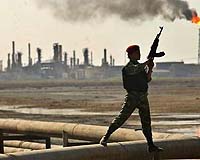
Islamist militants in Iraq have taken full control of the largest oil refinery in the country, though the government said Tuesday the claims are false.
The BBC reported Tuesday a "reliable source" has said militants with the Islamic State of Iraq and Syria have "full control" over the Baiji oil refinery. The British broadcaster reported there were 160 Iraqi soldiers inside the refinery who agreed to lay down their weapons in exchange for safe passage to Erbil, the capital of the semiautonomous Kurdish region of Iraq.
The refinery in Saladin province, north of Baghdad, has been closed at least since last week. It feeds the domestic market and a U.S. State Department spokeswoman said last week oil exports from Iraq weren't limited by the insurgency.
Sunni-led militants have taken control over key cities in northwestern Iraq.
The seizure of the Baiji oil refinery comes one day after U.S. Secretary of State John Kerry made a surprise visit to Baghdad to try to find a political solution to a crisis that erupted more than two years after U.S. combat forces left Iraq.
"Iraq is a strategic partner of the United States, with shared interests in countering the scourge of terrorism, maintaining stability of the global energy markets, and easing the sectarian polarization that plagues this region," Kerry said.
A military spokesman told the BBC they've been able to repel all terrorist attacks at Baiji.
US military advisers begin 'limited' mission in Iraq
Washington, United States (AFP) June 24, 2014 –
The first of up to 300 US military advisers began their mission in Baghdad Tuesday to help the Iraqi army, but the Pentagon said the American troops were not taking on a combat role.
The primary task of the advisers was to evaluate the state of the Iraqi forces and not to turn the tide against militants from the Islamic State of Iraq and the Levant (ISIL), which have swept across western and northern Iraq, the Pentagon's press secretary said.
"This isn't about rushing to the rescue," Rear Admiral John Kirby told reporters.
"These teams will assess the cohesiveness and readiness of Iraqi security forces …and examine the most effective and efficient way to introduce follow-on advisers," Kirby said.
The US troops, which included special operations forces, would relay their findings to commanders within "the next two to three weeks."
He did not say how long the advisers would be in place but said: "This is a limited, short-term duration mission."
Two teams of about 40 troops, which were drawn from the US embassy in Baghdad, "have started their new mission," Kirby said.
An additional 90 troops have arrived in Iraq to set up a joint operations center in the Iraqi capital and another 50 are due to deploy in the next few days, he said.
Combined with troops already stationed at the US embassy and others sent to bolster security there, the American military's presence in Iraq was now at about 500 forces, officials said.
After the stunning onslaught of ISIL militants, President Barack Obama announced plans to send the advisers to Baghdad last week while leaving open the possibility of eventual air strikes against the extremists.
The US military, which has deployed an aircraft carrier group to the Gulf, was ready to carry out bombing raids if called upon, Kirby said.
"We remain postured to do that," Kirby said.
But for the moment, the focus was on looking at the Iraqi forces and examining how additional teams of American advisers should be organized, he said.
"This is just the first day of the establishment of these assessment teams."
After swiftly advancing across a swath of territory in the north and west, ISIL forces are trying "to solidify those gains and to continue to threaten Baghdad," Kirby said.
He also said the United States had expanded its surveillance flights over Iraq, with manned and unmanned aircraft, and now was conducting 30 to 35 sorties a day.
In recent days, Iraqi forces have fended off assaults by ISIL at the Baiji oil refinery in the north, the country's largest, and the strategic western town of Haditha.
