
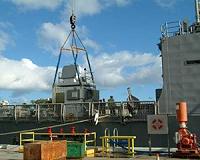
The U.S. and New Zealand are planning to show off missile systems during the massive Rim of the Pacific war game event that starts Thursday.
New Zealand's sea service plans to test launch a Penguin anti-ship missile from the Defense Force's new Seasprite helicopter, the New Zealand news site Newshub reports.
That helicopter deploys from the frigate Te Kaha. The Te Kaha is one of 45 ships and five submarines involved in the biennial RIMPAC exercise.
The Penguin is a helicopter-launched anti-ship missile originally developed by Norway, and further developed for use on LAMPS II helicopters and NATO allies.
It is a short-to-medium range inertially guided missile with infrared terminal homing. It fires in an indirect flight path to target and is operated in the "fire-and-forget" mode to allow multiple target prosecutions.
The USS Coronado littoral combat ship is also slated to fire a Harpoon anti-ship missile in an over-the-horizon demonstration during the exercise, {link:the U.S. Naval Institute reports.
: "https://news.usni.org/2016/05/04/navy-to-demo-harpoon-missile-on-lcs-at-rimpac-nsm-on-uss-freedom-by-next-deployment",nw}
RIMPAC features 27 nations, more than 200 aircraft and 25,000 personnel taking part in exercises in and around Hawaii and southern California.
U.S. Air Force orders decoy jammers from Raytheon for $118 million
Washington (UPI) Jun 30, 2016 –
Raytheon has received a $118 million firm-fixed-price U.S. Air Force contract for Lot 9 Miniature Air Launched Decoy Jammer, or MALD-J, vehicles and support equipment.
MALD is a modular, air-launched and programmable flight vehicle that protects aircraft and their crews by duplicating the combat flight profiles and signatures of aircraft.
MALD-J adds a radar-jamming capability to the platform.
Raytheon began MALD-J delivery in 2012.
Work for the latest contract will be performed in Arizona and is expected to be completed by June 2020.
The Air Force Life Cycle Management Center is the contracting activity.
