
Myanmar's junta has carried out air strikes on an ethnic armed group's base near the border with India, the rebels and media said Wednesday, with one bomb landing close to the international boundary.
The military coup almost two years ago has sparked renewed fighting with long-established ethnic rebel groups, as well as with dozens of "People's Defence Force" groups that have sprung up to oppose the junta.
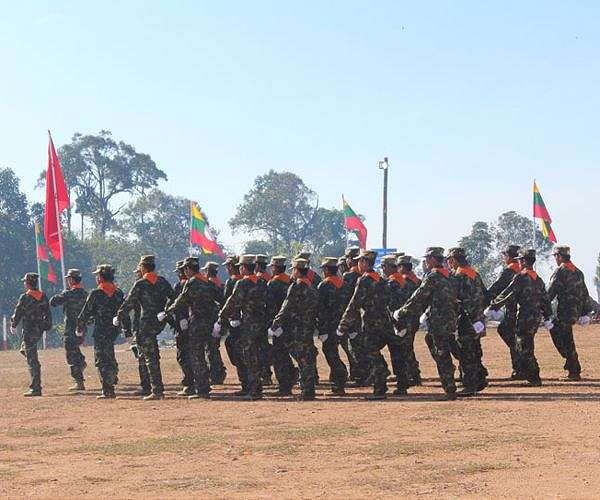
The bombing by five jets on Tuesday evening killed five fighters at the headquarters of the Chin National Front (CNF), which claims to represent the mainly Christian Chin minority in western Myanmar, spokesman Salai Htet Ni told AFP.
"They dropped seven bombs… Some of our houses were destroyed from their air strike… One bomb landed on the Indian side," he said.
Local media also reported five fighters had been killed and that one bomb landed in Champhai district, in India's Mizoram state.
But Indian police said the bomb had actually landed directly in the dry riverbed that marks the international boundary.
"Our initial investigation has revealed that there is no damage to any (Indian) life or property," Lalrinpuia Varte, police superintendent of Champhai district, told AFP.
"Farkawn village, which is about eight to nine kilometres (five to six miles) from the international border, is the closest to where the incident happened."
The CNF's fighters have dwindled in recent years, and it signed a ceasefire with the military in 2015.
But in May last year it signed an agreement with a shadow government dominated by lawmakers from Aung San Suu Kyi's National League for Democracy (NLD) that is working to overturn the coup.
Coup leader Min Aung Hlaing has justified his power grab by claiming electoral fraud in November 2020 elections won by Suu Kyi's NLD.
International observers said at the time the polls were largely free and fair.
UK vows no let-up with China after Jimmy Lai intervention
London (AFP) Jan 11, 2023 –
Britain will stand up to "Chinese aggression" and defend Hong Kong's freedoms, Prime Minister Rishi Sunak vowed Wednesday after his government intervened in the case of jailed media tycoon Jimmy Lai.
Minister for Asia Anne-Marie Trevelyan met the pro-democracy figure's legal team on Tuesday, prompting an angry response from the Hong Kong government.
But speaking in parliament, Sunak insisted on Britain's right to get involved in its former colony, whose civil liberties were meant to be guaranteed for 50 years under the Sino-UK agreement that came into effect in 1985.
The UK has admitted hundreds of thousands of Hong Kongers fleeing China's crackdown, he said, and it will remain "robust in standing up to what we believe to be Chinese aggression".
Britain would also resist the "undermining of the (50-year) settlement that we fought so hard to achieve".
Sunak was responding to China critic Iain Duncan Smith, who along with other MPs met earlier Wednesday with Lai's son Sebastien.
Jimmy Lai, 75, is a British citizen and founder of Hong Kong's now-shuttered Apple Daily newspaper.
He is facing up to life in prison for "colluding with foreign forces" — a crime under the security law Beijing imposed on Hong Kong to quash huge democracy protests in 2019.
His trial, scheduled for December last year, was pushed to September after Hong Kong authorities asked Beijing to step in and bar Lai from being represented by a London lawyer.
"We've been clear that the Hong Kong authorities must end their targeting of pro-democracy voices, including Jimmy Lai," Sunak's spokesman told reporters after the Trevelyan meeting.
Hong Kong's government responded: "We will never tolerate, and strongly deplore, any form of interference by any foreign power or individual with the (territory's) judicial proceedings and internal affairs."
