
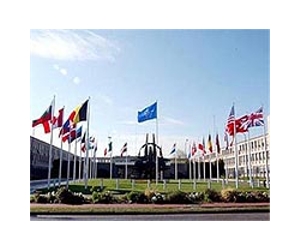
NATO secretary general Anders Fogh Rasmussen on Saturday urged "paper tiger" Europe to ramp up investment in a costly missile defence umbrella.
The alliance chief's remarks at a security conference in Brussels were largely aimed at the likes of EU heavyweights Germany, Italy and Spain, who fall substantially short of NATO military spending targets.
Britain and France, whose budgets are under ferocious pressure over the coming years having dug deep in a bid to insulate citizens from the worst economic slump since the 1930s, were also clearly in the Dane's sights.
"The Lisbon treaty provides the EU with a stronger defence and security policy dimension," said Rasmussen.
"But this will remain a paper tiger if it is not followed up by concrete military contributions when we need military contributions.
"Missile defence might be one key area whereby the Europeans can demonstrate such commitment… and also demonstrate to the American public that the alliance is relevant," he underlined.
Rasmussen's call, which echoes that of predecessors in the post down the years at key points in the development of all significant defence projects, is intended to keep defence spending among top priorities for nations often beset by large public deficits and debts.
He said that a decision to "invest in a comprehensive missile defence system" would send a powerful "political signal."
Rasmussen told his audience that a NATO summit in November represents a deadline for allies to fix plans to construct an integrated missile defence shield ideally stretching from Vancouver to Vladivostok.
Research has suggested that such a "security roof," as Rasmussen called it, could cost upwards of 20 billion dollars (15 billion euros) to build.
The most recently-available NATO figures for member states' defence spending, covering 2008, show Berlin, Rome and Madrid's respective percentages coming in well below NATO's stated goal of two percent of national output or GDP.
Germany, Italy and Spain are each on 1.3 percent.
Britain and France are both above the line, on 2.2 percent and 2.3 percent respectively, but Britain has the highest public deficit in Europe, equal to Greece at 12.7 percent of output, and France's military spending is seen as inflated by a heavy pensions element.
Greece was one of NATO's highest spenders proportionately in 2008, with 2.8 percent of output going on defence, but Athens has been forced by Brussels into radical spending cuts right across the board.
earlier related report
Nuclear treaty augurs well for Russia relations: NATO chief
Brussels (AFP) March 27, 2010 –
NATO chief Anders Fogh Rasmussen hailed Saturday a historic new nuclear arms reduction deal between the United States and Russia, saying it augurs well for alliance relations with Moscow.
Rasmussen told an audience in Brussels that the "welcome news" would not only "contribute to a safer world, it will also give impetus to cooperation with Russia in other fields including with NATO-Russia relations."
US President Barack Obama and his Russian counterpart Dmitry Medvedev on Friday finalised the agreement to cut long-range nuclear arms, which would see the number of deployed warheads reduced by a third.
The new pact, due to be signed April 8 in Prague, replaces the landmark 1991 Strategic Arms Reduction Treaty (START), which expired in December.
Rasmussen told top policymakers at a transatlantic conference that a "security roof" stretching from Vancouver to Vladivostok as sought by Russia should be built on missile defence cooperation between NATO and Moscow.
"I am suggesting nothing less than a radical change in the way we think about European security, about missile defence, and about Russia," he said.
"It would allow Europe to play an active role in a process which, until now, is conducted largely over their heads, by the US and Russia."
Rasmussen, who said Iran had gone "gone far beyond what is necessary for a purely civilian" nuclear programme, pointed to more than "30 countries" that have or are developing missile capabilities at ever-greater ranges.
As a result, "we need a missile defence system that includes not just all countries of NATO, but Russia too," the Dane said.
A NATO summit in November represents a deadline for allies to settle plans, he said, stressing that "we also need a decision from Russia — a decision to view missile defence as an opportunity, rather than a threat."
Anti-missile defence systems already in place within the NATO alliance fall under a US shield that has missile interceptors in the United States, Greenland and Britain.
Plans for it to be extended into eastern Europe have raised serious concern in Russia.
Share This Article With Planet Earth
