
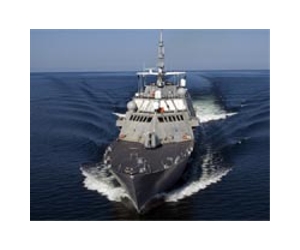
The Littoral Combat Ship Independence has joined the U.S. Navy despite plans by the Pentagon to kill a series of arms and defense programs.
The USS Independence was commissioned earlier this week at a ceremony in Mobile, Ala. The ship is the first LCS of the General Dynamics variant, but one of two sea frames being manufactured.
As part of the General Dynamics group, Australia-based Austal Ltd. is expected to receive fresh requests from the U.S. Navy for the second phase of the L.C.S program.
The U.S. Navy has said it plans to award a contract for up to 10 L.C.S vessels.
"A fast, agile and high-technology surface combatant, the Independence will be a platform for launch and recovery of manned and unmanned vehicles," said a Defense Department statement.
"To meet increased demand for mission-tailored forces packages, its modular design will support interchangeable mission packages, allowing the ship to be reconfigured for anti-submarine warfare, mine warfare or surface warfare missions on an as-needed basis," the statement added.
The LCS will be able to swap out mission packages pier side in a matter of days, adapting as the tactical situation demands.
The U.S. Defense budget has allotted $1.38 billion to buy two vessels in 2010. It includes a cost cap of $480 million for additional ships, with the L.C.S fleet expected to grow to a number of 55.
The Australian ship-builder Austal Ltd gets about half of the sale of each ship as the leading partner in the General Dynamics consortium.
The Defense Department said in its statement that the 127-meter Independence is designed for operation in shallow, near-shore environments to defeat "asymmetric" threats such as mines, piracy, submarines and terrorists or drug barons in small, swift surface crafts.
It will be manned by one of two rotational crews similar to those assigned to Trident submarines.
"This technological leap in naval warfare will deliver significant advantages, not only in terms of increased capability, but also through vastly reduced operating costs over the life of the vessel," said Austal Chief Executive Bob Browning.
Analysts say the U.S. Navy's decision to purchase a fleet of 55 L.C.S vessels sets a new course of development aimed to meet future challenges.
That shift, however, warn military analysts may compromise the Navy's initial mission capabilities that focused primarily on what is referred to as "blue water naval missions."
"It is not sufficiently shallow-draft to support our forces near and on shore, and is vulnerable to radar-controlled enemy weaponry," a report on the Defense News website said.
Pentagon reports leaked to U.S. media outlets suggest that the Pentagon is seeking to scrap at least 7 arms programs, including plans to kill a project to develop a new Navy cruiser and replace the Navy's EP-3 intelligence aircraft.
Share This Article With Planet Earth
